 XHLUX
XHLUX

Inhoudsopgave
- What Is an LED Linear Lighting System
- How LED Linear Lighting Systems Work
- Key Components of LED Linear Lighting Systems
- Advantages of LED Linear Lighting Systems
- Applications of LED Linear Lighting Systems
- Performance & Selection Guide
- Installation and Maintenance
- Conclusion
- Frequently Asked Questions (FAQ)
- Data Overview Table
In the evolution of architectural lighting, LED linear lighting systems have become a defining choice for modern commercial, residential, and industrial spaces. From offices and retail stores to hotels and homes, designers and engineers favor linear lighting for its clean aesthetics, uniform illumination, and energy efficiency.
Unlike traditional point light sources, LED linear lights create a continuous line of light that blends seamlessly with architectural structures. This integration of function and form has transformed the way spaces are illuminated — not just for brightness, but for atmosphere and visual harmony.
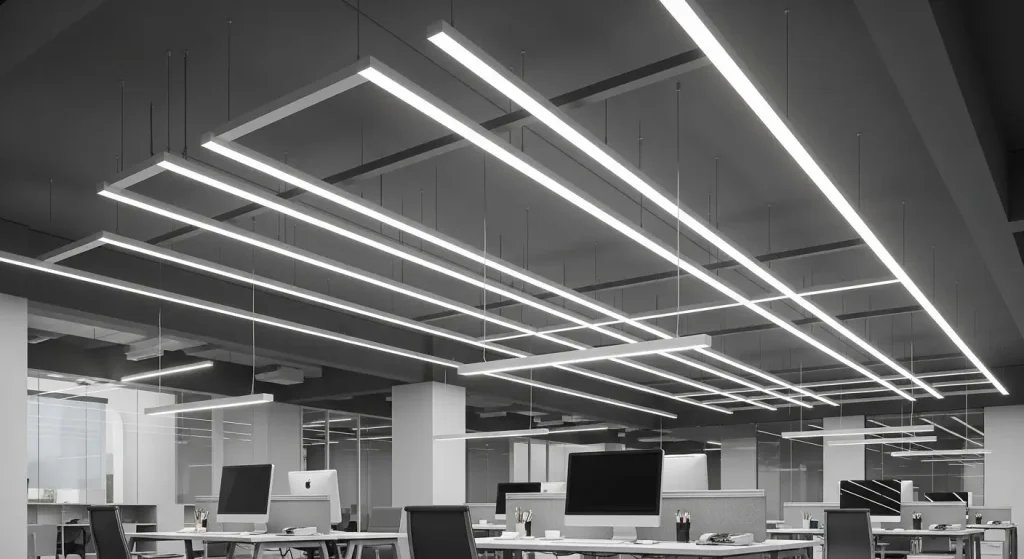
In this guide, we’ll explain how LED linear lighting systems work, break down their key components, and provide expert insights on performance, design selection, and maintenance.
What Is an LED Linear Lighting System
An LED linear lighting system is a modular setup consisting of linear LED modules, drivers, profiles, and diffusers, designed to deliver smooth, uniform light across a continuous surface.
Unlike standalone fixtures, linear systems are engineered as a complete architectural lighting solution. They can be installed in straight lines, geometric shapes, or curves — depending on the design concept.
Types of Linear Lighting Systems
| Type | Beschrijving | Typical Use |
|---|---|---|
| Continuous Linear System | Multiple fixtures connected seamlessly to form a continuous light line | Offices, retail stores |
| Modular Linear System | Predefined module units combined to fit specific lengths | Commercial projects |
| Magnetic Linear Track System | Plug-and-play modular track system for flexible arrangement | Showrooms, smart homes |
Difference from Traditional Lighting
Traditional fluorescent tubes or spotlights produce visible breaks and uneven brightness, while LED linear systems ensure consistent color and illumination across the entire line. The result: a modern, minimalist aesthetic that elevates any space.
Design Philosophy
LED linear lighting merges technology with architecture. It’s not just about light — it’s about how the light interacts with structure, form, and user experience.
How LED Linear Lighting Systems Work
1. Power Conversion (AC → DC)
LEDs operate on direct current (DC). When connected to an alternating current (AC) power supply, the driver converts AC into DC, regulating the current to prevent flicker or overload.
A stable DC current ensures the LEDs operate efficiently, maintain color consistency, and reach their full lifespan.
2. Light Generation Process
- Electrical current passes through the LED chip.
- De semiconductor junction emits photons (light).
- This light passes through optical lenses or diffusers, softening the brightness.
- The result: uniform illumination without glare or dark spots.
3. Control & Dimming
Modern LED linear systems can be controlled through various dimming technologies:
- 0–10V / 1–10V dimming for commercial environments.
- DALI control for smart building integration.
- Zigbee / Bluetooth / Wi-Fi for wireless, app-based control.
- Human-Centric Lighting (HCL) that adjusts brightness and color temperature throughout the day.
4. Modular Connection & Seamless Lighting
Each fixture connects via mechanical couplers and electrical connectors, allowing multiple modules to behave as one continuous light line.
Advanced optical diffusers ensure there are no visible joints or shadows — a key design feature for architectural lighting projects.
Key Components of LED Linear Lighting Systems
Understanding each component helps ensure optimal performance and longevity. Below we break down the five essential parts of a high-quality LED linear system.
1. LED Light Source / Module
De LED module is the heart of the system — responsible for converting electricity into light.
| Parameter | Typical Value | Beschrijving |
|---|---|---|
| Chip Type | SMD2835 / 5630 / COB | Determines brightness and color quality |
| Luminous Efficacy | 120–160 lm/W | Energy efficiency level |
| Color Temperature (CCT) | 2700K–6500K | Warm to cool white light options |
| CRI (Color Rendering Index) | ≥90 | Ensures accurate color perception |
- SMD LEDs are surface-mounted and ideal for uniform linear light.
- COB LEDs (Chip on Board) deliver higher brightness and smoother diffusion.
- Choosing the right combination of CCT and CRI is crucial for both aesthetics and comfort.
2. LED Driver / Power Supply
De driver acts as the system’s brain — regulating voltage, ensuring safety, and enabling dimming control.
| Type | Beschrijving | Application |
|---|---|---|
| Constant Voltage Driver | Maintains fixed output voltage | LED strips, low-voltage systems |
| Constant Current Driver | Maintains consistent current flow | High-power LED modules |
| Smart Driver | Supports DALI, Bluetooth, Zigbee | Smart building automation |
Key Performance Metrics:
- Efficiency: ≥88%
- Power Factor (PF): ≥0.95 for stable power use
- EMC Compliance: Ensures no electromagnetic interference
3. Aluminum Profile / Housing
De aluminum extrusion serves multiple purposes — it provides structural strength, heat dissipation, and aesthetic integration.
| Profile Type | Mounting Style | Typical Use |
|---|---|---|
| Recessed Profile | Flush into ceiling or wall | Offices, meeting rooms |
| Surface-Mounted Profile | Directly attached to surface | Corridors, industrial areas |
| Suspended Profile | Hanging installation with wires | Open-plan offices, showrooms |
Surface Finish Options:
Anodized, sandblasted, or powder-coated to match interior design styles.
4. Optical Diffuser / Lens
De diffuser controls light distribution and reduces glare.
Common materials include PMMA (acrylic) En PC (polycarbonate) with 80–95% light transmission.
Diffuser Options:
- Frosted (matte): Soft, even light with no hot spots.
- Micro-prismatic: Reduces glare and meets office lighting standards (UGR <19).
- Clear lens: Higher brightness, used for decorative effects.
5. Connectors & Accessories
These components enable mechanical stability En electrical continuity across fixtures.
- Quick-connect plugs for tool-free installation.
- L-, T-, and X-connectors for geometric designs.
- Mounting clips, suspension kits, and end caps ensure safe and professional assembly.
Advantages of LED Linear Lighting Systems
- Seamless Uniform Lighting – No dark spots or visible breaks.
- High Energy Efficiency – 50–70% lower energy consumption than fluorescent systems.
- Long Lifespan – Typically 50,000–70,000 hours.
- Flexible Design – Modular, customizable lengths and shapes.
- Smart Control Integration – Supports DALI, Bluetooth Mesh, or app-based systems.
- Sustainable & Eco-Friendly – Mercury-free, recyclable materials.
Performance Comparison Table
| Functie | LED Linear System | Fluorescent Tube | Halogen Light |
|---|---|---|---|
| Light Uniformity | ★★★★★ | ★★★☆☆ | ★★☆☆☆ |
| Efficiency (lm/W) | 140 | 90 | 25 |
| Lifespan (hours) | 50,000+ | 15,000 | 2,000 |
| Maintenance Cost | Laag | Medium | Hoog |
| Smart Control | ✔ Yes | ✖ No | ✖ No |
Applications of LED Linear Lighting Systems
LED linear lighting is widely adopted across industries for both functional and decorative purposes.
| Toepassingsgebied | Lighting Goal | Recommended Type |
|---|---|---|
| Kantoren en vergaderruimtes | Task and ambient lighting | Recessed or suspended linear lights |
| Retail Stores & Showrooms | Product highlighting | Magnetic or surface-mounted systems |
| Hotels & Corridors | Decorative ambient lighting | Warm-tone linear systems |
| Residential Projects | Modern aesthetic design | Cove and wall linear lights |
| Building Facades | Architectural contour lighting | Waterproof IP65 profiles |
| Industrial Spaces | Energy-efficient general lighting | Surface-mounted linear fixtures |
Performance & Selection Guide
When selecting an LED linear lighting system, consider the following technical aspects:
1. Power Density & Brightness
Choose suitable W/m En lm/m based on space usage:
- Offices: 10–15 W/m, 1200–1500 lm/m
- Retail: 20–25 W/m, 2000+ lm/m
2. CCT & CRI Selection
| Environment | Recommended CCT | CRI Requirement |
|---|---|---|
| Offices | 4000–5000K | ≥80 |
| Hotels | 2700–3000K | ≥90 |
| Retail | 3500–4000K | ≥90 |
| Art Spaces | 3000–3500K | ≥95 |
3. IP Rating
Indoor applications: IP20–IP40
Outdoor or damp locations: IP65+
4. Control System Compatibility
Ensure your drivers and controllers support DALI, DMX, or wireless systems for future scalability.
Installation and Maintenance
- Pre-Installation Check: Verify voltage and driver compatibility.
- Proper Wiring: Ensure polarity alignment for DC connections.
- Secure Mounting: Use manufacturer-provided clips or brackets.
- Heat Management: Maintain ventilation for long-term stability.
- Regular Cleaning: Dust-free diffusers maintain 100% light output.
💡 Tip: Always test the entire system before ceiling closure to prevent wiring issues.
Conclusion
LED linear lighting systems combine technology, design flexibility, and energy performance to redefine modern lighting.
Their modular structure, seamless illumination, and smart control capabilities make them an ideal choice for architectural, commercial, and residential applications.
Whether you are designing an office, retail store, or smart building, a well-planned LED linear system ensures efficiency, comfort, and timeless aesthetics.
Contact [XHLUX Verlichting] today to discover customized LED linear lighting solutions and OEM/ODM services for your next project.
Frequently Asked Questions (FAQ)
Q1: What makes LED linear lighting different from standard LED lights?
Linear systems use multiple LED modules connected in sequence to create continuous, uniform light — unlike single-point LED fixtures.
Q2: How important is the LED driver in performance?
Very important. The driver stabilizes current, prevents flicker, and directly impacts lifespan and efficiency.
Q3: Can LED linear lights be connected to smart control systems?
Yes. They can integrate with DALI, Zigbee, Bluetooth, or Wi-Fi systems for wireless dimming and scheduling.
Q4: Do I need a professional electrician to install linear lighting?
For large projects, yes. Proper wiring and mounting ensure safety and performance.
Q5: How do continuous linear systems achieve no dark gaps?
High-density LEDs, precision connectors, and optical diffusers are used to eliminate visual breaks between modules.
Data Overview Table
| Specification | Value | Notes |
|---|---|---|
| Luminous Efficacy | 120–160 lm/W | Depends on LED chip type |
| Power Factor | ≥0.95 | Efficient energy use |
| CRI | ≥90 | High color accuracy |
| Lifespan | 50,000–70,000 hrs | Based on thermal management |
| Dimming Protocols | 0–10V, DALI, Zigbee | Optional smart control |
| Operating Temp. | -20°C to +50°C | Indoor/outdoor range |