 XHLUX
XHLUX

Inhoudsopgave
- 1. Why the Hotel Experience Begins with Being “Surrounded by Light”
- 2. What Is Hotel Ambient Lighting?
- 3. Why Hotel Projects Cannot Apply Generic Commercial Ambient Lighting Logic
- 4. Why LED Has Become the Mainstream Choice for Hotel Ambient Lighting
- 5. Ambient Lighting Design Logic Across Hotel Functional Zones
- 6. Ambient Lighting vs Accent and Decorative Lighting in Hotels
- 7. Key Factors When Choosing LED Hotel Ambient Lighting
- 8. The Role of Ambient Lighting in Hotel Brand Replication
- 9. Common Mistakes in Hotel Ambient Lighting Design
- 10. FAQ About Hotel Ambient Lighting
- 11. Why LED Hotel Ambient Lighting Is Core Hospitality Infrastructure
- Business inquiries are welcome
1. Why the Hotel Experience Begins with Being “Surrounded by Light”
A hotel is not a purely functional space. It is an experience-driven environment, where emotion, comfort, and perception matter as much as efficiency.
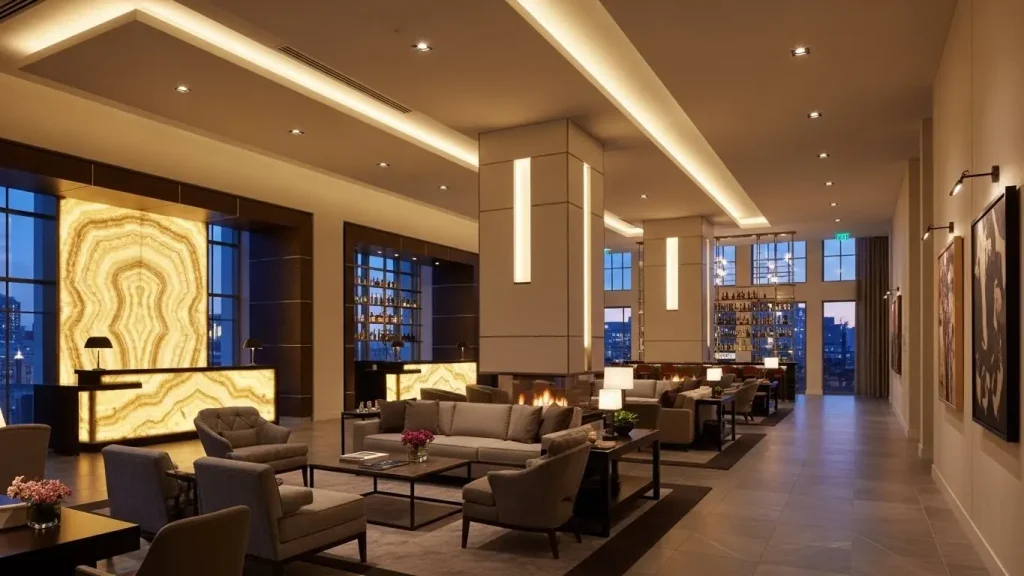
A guest’s first impression of a hotel is rarely formed by decorative fixtures. Instead, it comes from subtle, instinctive judgments:
- Does the lobby feel welcoming or overwhelming?
- Are corridors calm and reassuring, or harsh and tiring?
- Does the guestroom feel relaxing after a long journey?
In most cases, these impressions are shaped not by feature lighting, but by ambient lighting—the continuous, background light that defines how a space feels before anything else is noticed.
This is why professionals searching for hotel ambient lighting are not simply looking for LED products. They are asking a deeper question:
How can LED ambient lighting create a comfortable, brand-consistent, and operationally reliable hotel environment—one that can be replicated across properties and sustained over time?
2. What Is Hotel Ambient Lighting?
Ambient lighting refers to the base layer of illumination that fills a space evenly and continuously.
The Role of Ambient Lighting in Hotels
In hospitality projects, ambient lighting does not aim to attract attention. Instead, it serves to:
- Establish the emotional tone of a space
- Define comfort levels
- Support all other lighting layers
Ambient Lighting vs Other Lighting Layers
| Lighting Layer | Primary Role |
|---|---|
| Sfeerverlichting | Emotional baseline and comfort |
| Accentverlichting | Visual emphasis and guidance |
| Decorative lighting | Identity and memorability |
If accent or decorative lighting is the “foreground,” ambient lighting is the canvas.
One-sentence definition:Hotel ambient lighting is the foundational lighting system that defines comfort, mood, and spatial continuity throughout a hotel.
3. Why Hotel Projects Cannot Apply Generic Commercial Ambient Lighting Logic
This is where many hospitality projects fail.
How Hotels Differ from Offices and Retail
Hotels differ fundamentally in three ways:
- Operating time: lighting often runs 16–24 hours per day
- Scene variety: guests experience multiple emotional states in one visit
- Sensitivity: comfort expectations are much higher
Common Mistakes in Hotel Ambient Lighting
- Excessive brightness that feels like an office
- Cold color temperatures that reduce relaxation
- Abrupt lighting transitions that disrupt experience
In hospitality environments:“Bright enough” has never been a meaningful lighting standard.Comfort, continuity, and emotional coherence matter far more.
4. Why LED Has Become the Mainstream Choice for Hotel Ambient Lighting
This section bridges technology with business reality.
Why LED Fits Hospitality Requirements
LED technology aligns naturally with hotel operations because it offers:
- Long-term stability
- High energy efficiency
- Smooth dimming capability
- Compatibility with centralized control systems
Compared with traditional light sources, LED luminaires are better suited to long operating hours and frequent scene adjustments.
From an operational perspective:LED is not chosen to showcase technology—it is chosen to support sustainable hotel operations.
5. Ambient Lighting Design Logic Across Hotel Functional Zones
Ambient lighting must adapt to different hotel zones while maintaining a coherent identity.
Typical Zone-Based Logic
Lobby & Public Areas
- Create the first emotional impression
- Express brand positioning
- Balance openness with comfort
Corridors & Elevator Lobbies
- Continue, gelijkmatige verlichting
- Avoid excessive brightness
- Reinforce safety and calm
Guestrooms
- Soft, adjustable ambient light
- A sense of privacy and relaxation
- Often combined with scene control
Restaurants & Bars
- Ambient light shifts with time and activity
- Supports dining rhythm rather than dominating it
SPA & Wellness Areas
- Lower illuminance
- High visual comfort
- Strong emphasis on relaxation
Core principle:👉 Ambient lighting adapts to function, but must remain emotionally consistent across the hotel.
6. Ambient Lighting vs Accent and Decorative Lighting in Hotels
Understanding hierarchy is critical.
- Ambient lighting defines the base tone
- Accent lighting adds focus and structure
- Decorative lighting creates memory points
If ambient lighting is poorly designed, even the most expensive chandeliers or feature fixtures will feel out of place.
For hotel lighting design, the order is always:Ambient lighting → Accent lighting → Decorative lighting
7. Key Factors When Choosing LED Hotel Ambient Lighting
This section directly supports real project decision-making.
Praktische evaluatiechecklist
| Factor | Why It Matters in Hotels |
|---|---|
| Color temperature | Influences relaxation and brand perception |
| Color rendering | Affects skin tone and material appearance |
| Glare control | Essential for long-term visual comfort |
| Dimming capability | Enables scenes and time-based operation |
| Long operating life | Reduces maintenance disruption |
| Low visual presence | Fixtures should not dominate ceilings |
| Ease of maintenance | Critical for operational efficiency |
Many hotel projects integrate ambient lighting with digital control systems such as those defined by the DALI Alliance.For general background, seeWikipedia’s overview of DALI.
Key reminder:Good hotel ambient lighting is easy to feel—but difficult to describe.
8. The Role of Ambient Lighting in Hotel Brand Replication
For hotel groups and chains, lighting is part of brand identity.
Why Ambient Lighting Supports Brand Consistency
- Creates a recognizable emotional atmosphere
- Reduces design variability between properties
- Improves project delivery consistency
- Lowers post-opening complaints and adjustments
For multi-property operators:
Ambient lighting becomes an invisible brand standard.
Standardized fixture strategies—often combiningLED-downlights,LED Linear Lighting,and centralized commerciële verlichtingsoplossingen—enable reliable replication across regions.
9. Common Mistakes in Hotel Ambient Lighting Design
These issues repeatedly appear in unsuccessful projects.
Veelvoorkomende fouten
- Treating ambient lighting as secondary
- Mixing inconsistent color temperatures
- Ignoring dimming and scene control
- Over-relying on decorative fixtures
- Prioritizing specifications over guest experience
Important reminder:
Hotel lighting fails more often due to discomfort than insufficient brightness.
10. FAQ About Hotel Ambient Lighting
Q1: Must hotel ambient lighting always be warm?
Usually yes, but brand positioning may justify neutral tones in some areas.
Q2: Does every zone require dimming?
Public areas and guestrooms benefit the most.
Q3: Does ambient lighting significantly affect energy use?
Yes—but LED combined with dimming can greatly reduce consumption.
Q4: Is LED ambient lighting suitable for hotel renovations?
Very much so; it is often a priority upgrade.
Q5: Does ambient lighting need frequent replacement?
Well-designed systems remain stable for many years.
11. Why LED Hotel Ambient Lighting Is Core Hospitality Infrastructure
Hotel experience begins with how a space feels, not how bright it is.
Ambient lighting defines whether a hotel feels calm, welcoming, and memorable.
LED hotel ambient lighting enables:
- Stable guest experience
- Manageable, long-term operations
- Brand-consistent replication
For hotel owners and operators, this is not a decorative choice—it is core infrastructure with long-term return.
Final takeaway:Hotel ambient lighting is the quietest, yet most influential factor in hospitality success.
Business inquiries are welcome
If you are planning a hotel project—new build or renovation—and want to align ambient lighting comfort, control strategy, and long-term operations, early coordination is essential.
If you would like support selecting suitable LED ambient lighting fixtures, defining control logic, or building a coherent hotel lighting system, you can
👉 request a project-based lighting consultation and share your project background.
This allows your lighting design to move beyond individual products and become a repeatable, brand-level hospitality solution.