 XHLUX
XHLUX

Inhoudsopgave
- Why Downlight Spacing Causes More Hotel Complaints Than Fixture Choice
- Why Downlight Spacing Matters in Hotel Lighting Design
- Key Factors That Determine Hotel Downlight Spacing
- General Downlight Spacing Guidelines for Hotel Projects
- Chart 1: Quick Spacing Reference Matrix (Hotel-Friendly Starting Ranges)
- Downlight Spacing by Hotel Area (Corridor vs Guestroom vs Lobby)
- How Downlight Spacing Affects Glare and Visual Comfort
- Chart 2: “Symptoms → Cause → Fix” Spacing Troubleshooting Table
- Common Downlight Spacing Mistakes in Hotel Lighting Projects
- How to Optimize Downlight Spacing for Hotel Projects
- Step 1: Define the Zone Function and Comfort Risk
- Step 2: Select the Right Optics Before Spacing
- Step 3: Use Reference Spacing Ranges, Then Validate Overlap
- Step 4: Layer Lighting Instead of Overloading Downlights
- Step 5: Plan for Controls and Night Mode (If Required)
- Step 6: On-Site Verification (The Real Risk Reducer)
- Why “Spacing Fixes” Often Fail Without Optics Strategy
- Comparison Table: Corridor vs Guestroom vs Lobby Spacing Priorities
- FAQ About hotel downlight spacing
- 1) How far apart should downlights be in hotels?
- 2) What is the best spacing for hotel corridor downlights?
- 3) Can downlights be spaced too close?
- 4) How does ceiling height affect downlight spacing?
- 5) Are LED downlights suitable for hotel lighting?
- 6) Should all hotel areas use the same downlight spacing?
- 7) Is beam angle enough to decide spacing?
- Conclusion
- Business inquiries are welcome
Why Downlight Spacing Causes More Hotel Complaints Than Fixture Choice
Hotel lighting is judged differently from most commercial environments. Guests experience it when they are tired, often at night, and in spaces where visual comfort matters as much as safety. That’s why improper hotel downlight spacing is one of the fastest ways for a “good-looking lighting plan” to turn into complaints after opening.
Improper downlight spacing is a common cause of glare, dark spots, and uncomfortable lighting in hotel projects—even when premium fixtures are used.
When downlights are spaced incorrectly, hotel corridors can feel harsh and “runway-like,” guestrooms can feel patchy or too bright over the bed, and project teams may face costly on-site adjustments (re-aiming, adding fixtures, changing wattage, replacing optics, or reworking ceilings).
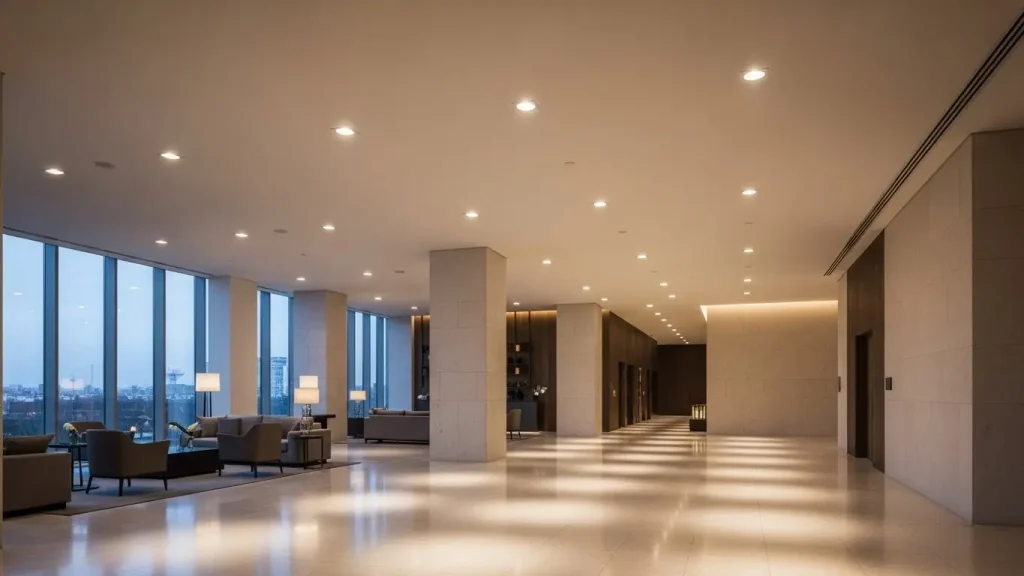
By applying professional spacing logic—based on ceiling height, beam angle, optical design, and functional zoning—hotels can achieve lighting that feels calm, safe, and premium while reducing maintenance and rework risk.
This guide explains the real-world spacing logic used by hospitality lighting designers and project teams. It avoids the “one fixed spacing number” trap and instead gives you practical decision tools, tables, and checklists you can apply to corridors, guestrooms, lobbies, and public areas.
If you are evaluating low-glare, hospitality-grade recessed fixtures, you can review professional options in our LED spot downlight series and compare specifications in the product catalog.
Why Downlight Spacing Matters in Hotel Lighting Design
Downlight spacing isn’t a minor drafting detail. In hotel environments, it controls three outcomes that directly affect guest perception and operational success:
1) Lighting Uniformity (Comfort + Perceived Quality)
Guests don’t judge a corridor or guestroom by measured lux at a single point. They judge the space by how it feels while moving through it. Poor spacing creates:
- visible bright “spots” with dark gaps
- inconsistent door and wall visibility
- shadow patches that make finishes look worn or dirty
- a “cheap” visual rhythm even if fixtures are expensive
Uniformity is a key factor of perceived quality in hospitality: smooth transitions signal professional design.
2) Glare Risk (Night Sensitivity + Complaints)
Hotels are nighttime-sensitive environments. Guests stepping into a corridor at 2:00 a.m. have eyes adapted to darkness. In that moment, glare is not a small annoyance—it can feel aggressive and intrusive.
Spacing affects glare in two ways:
- spacing too tight increases overall brightness and perceived harshness
- spacing too wide forces higher output or narrower beams, which increases hotspots and discomfort glare
For broader comfort context, many professionals reference indoor lighting comfort frameworks such as EN 12464-1 and glare-related metrics like UGR (Unified Glare Rating).
Even when a hotel project doesn’t formally specify UGR, the comfort logic is still highly relevant.
3) Spatial Rhythm (Atmosphere + Brand Tone)
Hotels need corridors and public spaces to feel calm, not like an airport terminal. Spacing controls whether the ceiling becomes a pleasing rhythm or a dotted “runway.”
4) Operational Cost (24/7 Use + Maintenance Cycles)
Corridor and public area downlights often run for long hours, sometimes 24/7. Spacing influences:
- number of fixtures → capital cost
- wattage per fixture → heat and driver stress
- maintenance frequency → downtime and staffing cost
A correct spacing plan reduces the need for “overdriving” fixtures, which supports long-term reliability.
Why is downlight spacing important in hotel lighting?
Because it directly affects uniformity, glare risk, visual rhythm, and long-term operational efficiency.
Key Factors That Determine Hotel Downlight Spacing
Most spacing mistakes come from treating downlights like a commodity. In professional hotel lighting design, spacing is a function of geometry + optics + application.
Ceiling Height (The Primary Geometry Driver)
Ceiling height determines how wide a beam spreads before it hits the floor and vertical surfaces.
- Higher ceilings allow wider spacing because light has room to spread and overlap.
- Lower ceilings require tighter control: either closer spacing, wider beams, or better optical diffusion—otherwise hotspots and glare become obvious.
In hotels, typical ceiling heights differ by zone:
- corridors often 2.4–2.8 m
- guestrooms often 2.4–2.7 m
- lobbies and public areas can be 3.5–8 m+
This alone means “one spacing number” cannot work across the building.
Beam Angle of the Downlight (How Wide the Core Cone Is)
Beam angle strongly influences spacing because it affects beam diameter at the target plane.
- Narrow beams (15°–24°): require closer spacing to avoid dark gaps; best for accent zones
- Medium beams (24°–36°): most common and safest for hospitality general + task layers
- Wide beams (36°–60°): allow wider spacing and smoother overlap; good for corridors and ambient layers
Beam angle definition is often referenced as a technical baseline here: beam angle definition.
Lumen Output and Optical Design (Why “More Lumens” Doesn’t Solve Spacing)
A common mistake is assuming higher lumens allow wider spacing. In reality:
- pushing higher lumens may increase glare
- higher output doesn’t fix poor overlap or harsh beam edges
- “hotspot” intensity becomes more noticeable at low ceiling heights
In hospitality projects, optical design is often more important than raw lumen output. Look for:
- low-glare architecture (deep recess / controlled cut-off)
- high-quality lens systems (often PMMA-lens for clean optics and smooth transitions)
- consistent beam quality (no artifacts, stable edge behavior)
Reflectance and Surface Finish (Hotels Are Full of Glare Triggers)
Corridors may include:
- glossy wall paint
- polished stone skirting
- metal door numbers and signage
- framed artwork under glass
These reflective elements can amplify glare and hotspots. Spacing and beam selection must consider finish reflectance.
Zone Function and Viewing Behavior (How People Use the Space)
Hotel zones have different viewing behavior:
- corridors: long walking sightlines, frequent night use
- guestrooms: seated/lying views, direct glare sensitivity near bed
- lobbies: mixed viewing angles, higher ceilings, layered lighting
What factors determine downlight spacing in hotels?
Ceiling height, beam angle, optical design quality, output level, finish reflectance, and the function of each hotel area.
General Downlight Spacing Guidelines for Hotel Projects
Many online guides claim “space downlights 1.2 m apart” or “1.5 m is standard.” That approach ignores the real variables that define hospitality comfort.
A more professional starting point is to understand spacing as overlap management:
- too little overlap → dark gaps, patchy rhythm
- too much overlap → overbright, glare risk, wasted energy
The Practical Geometry: Beam Diameter at Floor Level
A simplified way to estimate beam diameter:
- Beam radius ≈ mounting height × tan(beam angle / 2)
- Beam diameter ≈ 2 × mounting height × tan(beam angle / 2)
But hospitality design typically requires overlap for uniformity, so spacing is often some percentage of beam diameter—depending on how soft the beam edge is.
Spacing Isn’t Just Floor Illumination—It’s Also Vertical Illumination
Hotels need door faces and signage visible. That often requires a lighting plan that supports vertical surfaces, not only the floor. Sometimes that means:
- slightly offset rows
- wall-oriented optics
- complementary linear wall-wash layers (especially premium corridors)
For softer ambient support, many hospitality designers combine recessed downlights with linear lighting in public areas to reduce harsh contrast.
What is the typical spacing for hotel downlights?
Many hotel projects fall in the 1.2–1.8 m range, but correct spacing must be adjusted based on ceiling height, beam angle, optical behavior, and zone function.
Chart 1: Quick Spacing Reference Matrix (Hotel-Friendly Starting Ranges)
Important: These are reference ranges for early planning—not universal rules. Beam edge softness, cut-off design, and target uniformity can shift the final decision.
Table: Suggested Downlight Spacing by Ceiling Height and Beam Angle
| Ceiling Height | 24° Beam | 36° Beam | 60° Beam |
|---|---|---|---|
| 2.4–2.6 m | 1.0–1.3 m | 1.2–1.6 m | 1.5–2.0 m |
| 2.6–2.8 m | 1.1–1.4 m | 1.3–1.7 m | 1.6–2.1 m |
| 2.8–3.2 m | 1.2–1.6 m | 1.5–2.0 m | 1.9–2.5 m |
| 3.2–4.0 m | 1.5–2.0 m | 1.9–2.6 m | 2.4–3.2 m |
How to use this table correctly:
- If your optics are tight / hard-edged, stay toward the lower spacing range.
- If your optics are soft / smooth transition, you can move toward the higher range.
- If your corridor is glossy or nighttime-sensitive, bias toward smoother overlap (avoid runway spots).
Downlight Spacing by Hotel Area (Corridor vs Guestroom vs Lobby)
This is where most competitors fail: they treat the hotel as one space. Real hotel lighting design must be zoned, because each area has different comfort risk and operational priorities.
Hotel Corridor Downlight Spacing (Uniformity + Night Comfort First)
Corridors are the most complaint-sensitive area because guests use them at night. Spacing strategy should prioritize:
- no visible dark patches along walking path
- calm rhythm (avoid runway effect)
- low glare (source not visible at shallow angles)
- door faces and signage visibility
Practical corridor logic:
- Use medium-to-wide beams (often 36°–60°) with soft distribution
- Use tighter spacing than you would in an office with the same ceiling height, because corridor perception is more continuous and nighttime-sensitive
- Avoid narrow beams unless you are lighting artwork niches specifically
Runway effect warning:
If you see “bright circles” on the floor separated by darkness, spacing is too wide for your beam, or your beam is too tight for the corridor width.
Internal solution path:
For corridor base lighting, glare-controlled recessed options like LED spot downlights are commonly preferred because the recessed architecture naturally improves comfort.
Hotel Guestroom Downlight Spacing (Comfort + Bed Zone Sensitivity)
Guestrooms differ from corridors because viewing is often:
- seated (desk)
- lying down (bed)
- facing toward ceiling fixtures
That means glare risk can be higher even at lower brightness.
Guestroom spacing strategies:
- Don’t use a uniform grid across the entire guestroom unless the design requires it.
- Use layered lighting: ambient + task + accent.
- Keep downlights away from direct bed sightlines when possible.
- Use controlled optics, not high lumen, to avoid harshness.
A practical guestroom approach might include:
- downlights for circulation and general ambient rhythm
- separate reading lights / bedside lamps
- optional accent for artwork or wardrobe area
For flexible accent layers, some designs incorporate limited LED-railverlichting in suites or boutique rooms, but recessed downlights remain the comfort anchor in most guestrooms.
Hotel Lobby and Public Areas (Higher Ceilings + Layered Composition)
Lobbies typically have higher ceilings and a stronger decorative component. Here, spacing becomes more flexible because:
- mounting height is higher
- layered lighting is expected
- decorative fixtures often set visual identity
Lobby strategy is rarely “just downlights.” Instead:
- use downlights for functional base
- add decorative elements for brand feel
- add linear or indirect layers to reduce contrast
- use accent where focal zones exist (reception desk, seating clusters, art)
If your lobby includes decorative elements and branded atmosphere, consider using downlights as the functional backbone and complementing with pendant lighting where appropriate—while still keeping glare control and uniformity under control.
How Downlight Spacing Affects Glare and Visual Comfort
Spacing problems show up in hotel projects in predictable ways.
If Spacing Is Too Wide
You often get:
- dark gaps between pools of light
- “patchy” corridor feel
- guests feel unsafe, especially at night
- project team compensates by increasing lumen output → glare risk rises
If Spacing Is Too Tight
You often get:
- over-bright ceilings and floors
- excessive brightness along the walking path
- discomfort glare, especially in low corridors
- energy waste and increased thermal/driver stress
Why Anti-Glare Design Beats “Spacing Tricks”
Many teams try to fix glare by changing spacing alone. But if the fixture has poor glare control (visible source, poor cut-off), tighter spacing can actually worsen discomfort.
The more reliable approach is:
- choose optics designed for comfort (deep recess / controlled cut-off)
- choose a beam appropriate for the zone
- then space for overlap and rhythm
For reference, projects that require strong visual comfort (especially offices) often specify targets like “UGR <19.” Hotel corridors are different, but the principle remains: visual comfort is a design baseline, not an optional upgrade. UGR definition.
How does downlight spacing affect glare?
Wide spacing increases dark gaps and forces higher output, while tight spacing can create over-brightness. Proper spacing improves uniformity and comfort—especially when combined with low-glare optics.
Chart 2: “Symptoms → Cause → Fix” Spacing Troubleshooting Table
Table: Common Spacing Symptoms in Hotels and Practical Fixes
| What You See On Site | Likely Root Cause | Most Effective Fix |
|---|---|---|
| Bright circles + dark gaps (runway effect) | beam too narrow and/or spacing too wide | use wider/softer beam or reduce spacing |
| Corridor feels harsh at night | over-brightness + visible source glare | low-glare optics + reduce output + adjust spacing overlap |
| Door numbers hard to read | floor lit, vertical surfaces underlit | adjust layout for vertical illumination (offset / wall-oriented) |
| Hotspots on glossy signage | high-angle spill / poor cut-off | better cut-off optics + aim / placement adjustments |
| Guestroom bed area feels “shiny” | fixture in direct sightline | reposition downlights away from bed, add task lighting instead |
Common Downlight Spacing Mistakes in Hotel Lighting Projects
This section is about risk avoidance—exactly what professional buyers care about.
Mistake 1: One Spacing for the Entire Hotel
Lobby, corridor, and guestroom have different ceiling heights, functions, and comfort needs. A single spacing number across all areas is almost guaranteed to fail somewhere.
Mistake 2: Ignoring Nighttime Experience
A corridor that looks acceptable at 10 a.m. can feel unbearable at 2 a.m. Nighttime walkthroughs should be part of the verification process.
Mistake 3: Using Brightness to Hide Layout Issues
If spacing creates dark gaps, some teams simply increase lumens. This often increases glare and makes the space feel more commercial than hospitality.
Mistake 4: Spacing Without Beam/Optics Consideration
Two downlights labeled “36°” can behave differently depending on lens design and cut-off. Spacing must be validated against actual beam behavior, not only catalog numbers.
Mistake 5: Only Considering Initial Fixture Cost
Hotels are operational businesses. Spacing influences quantity, wattage, driver stress, and maintenance frequency. A “cheap per unit” choice can become expensive when the system runs long hours.
What are common hotel downlight spacing mistakes?
Using uniform spacing across all areas, ignoring ceiling height and night experience, relying on brightness to fix layout issues, and underestimating optical quality.
How to Optimize Downlight Spacing for Hotel Projects
Instead of starting with a spacing number, start with the hotel’s performance goals, then work through a repeatable process.
Step 1: Define the Zone Function and Comfort Risk
Ask:
- Is this corridor primarily night-use sensitive?
- Is this guestroom with bed sightline sensitivity?
- Is this a lobby where layering and brand identity dominate?
Step 2: Select the Right Optics Before Spacing
For hospitality-grade results, prioritize:
- low-glare design (deep cut-off, recessed source)
- smooth distribution (no harsh beam edges)
- stable color quality
Typical hospitality specifications often include:
- CRI >90 (Ra97 for premium finish rendering)
- SDCM <3 for color consistency across long corridors
- reliability targets such as L70/B50 50.000 uur
- efficiency typically in the 100–130 lm/W range (application and optics dependent)
From an engineering standpoint, robust construction matters:
- koelblok van gegoten aluminium for thermal stability
- quality PMMA-lens for consistent beam control
- reliable LED engine such as a COB chip where beam quality and uniformity are priorities
If your project requires fixtures built around these fundamentals, review professional recessed downlights and compare models in the product catalog.
Step 3: Use Reference Spacing Ranges, Then Validate Overlap
Use the spacing matrix (Chart 1) to choose an initial range, then adjust based on:
- beam edge softness
- reflectance (glossy surfaces need softer overlap)
- required rhythm (avoid runway effect)
Step 4: Layer Lighting Instead of Overloading Downlights
Many spacing failures happen because downlights are asked to do everything. A better hotel approach is layered lighting:
- downlights for base comfort and navigation
- wall/vertical emphasis for orientation and premium feel
- optional low-level night mode in corridors
- decorative layers in lobbies
For premium corridors and public areas, adding a soft ambient layer via linear lighting can reduce contrast and improve comfort—often allowing downlights to be spaced more naturally without harsh hotspots.
Step 5: Plan for Controls and Night Mode (If Required)
Hotels often benefit from:
- daytime scene for clarity
- nighttime scene for comfort
- emergency mode integration
Where centralized control is needed, protocols like DALI
are commonly used in commercial projects to support dimming scenes and monitoring.
Step 6: On-Site Verification (The Real Risk Reducer)
Before final acceptance:
- perform a nighttime walkthrough
- check glare at room exits
- verify door number readability
- check for hotspot reflections on signage and artwork
Why “Spacing Fixes” Often Fail Without Optics Strategy
In many hotel retrofit situations, the initial complaint is:
“Corridor is too harsh,” or “Guestroom looks patchy.”
The first attempted fix is often adjusting spacing or dimming. But the projects that achieve stable comfort outcomes typically focus on optics + placement together:
- switching to deeper cut-off, glare-controlled downlights
- selecting a beam distribution with softer transitions
- rebalancing spacing to create overlap rather than isolated hotspots
- using layered lighting so downlights aren’t pushed too hard
This is why downlight spacing should be treated as a system decision (comfort + safety + operations), not just a drafting number.
If you want to reduce rework risk, it’s usually more cost-effective to validate optics and spacing early through a structured hospitality lighting solution approach, supported by real application references in project cases.
Comparison Table: Corridor vs Guestroom vs Lobby Spacing Priorities
Chart 3: Hotel Zone Spacing Priorities
| Hotel Area | Primary Goal | Spacing Bias | Typical Beam Approach | Key Risk to Avoid |
|---|---|---|---|---|
| Corridor | safety + night comfort | slightly tighter, smoother overlap | 36°–60° soft distribution | runway effect, glare at night |
| Guestroom | comfort + bed sightlines | zoned spacing, not uniform grid | mixed: ambient + task layers | direct glare from bed |
| Lobby/public | brand + layered atmosphere | flexible, depends on layers | downlights + decorative + linear | patchy base or harsh contrast |
FAQ About hotel downlight spacing
1) How far apart should downlights be in hotels?
Most hotel projects end up in a 1.2–1.8 m spacing range in many areas, but the correct spacing depends on ceiling height, beam angle, optical design, and zone function. Use reference ranges first, then validate overlap and comfort.
2) What is the best spacing for hotel corridor downlights?
Corridors are night-sensitive and complaint-prone, so spacing often needs to support smooth overlap and avoid runway hotspots. Medium-to-wide beams (36°–60°) with glare-controlled optics are commonly used, and spacing is typically tighter than in higher-ceiling commercial corridors.
3) Can downlights be spaced too close?
Yes. Spacing too close can cause over-brightness, increased glare, wasted energy, and higher driver/thermal stress—especially in low ceilings.
4) How does ceiling height affect downlight spacing?
Higher ceilings allow wider spacing because the beam has room to spread and overlap. Lower ceilings usually require closer spacing, wider beams, or softer optical distribution to avoid hotspots and glare.
5) Are LED downlights suitable for hotel lighting?
Yes—LED downlights are ideal for hotels due to efficiency and long lifetime. The key is choosing low-glare optics, hospitality-grade color quality (CRI >90 / Ra97, SDCM <3), and stable drivers designed for long operating hours.
6) Should all hotel areas use the same downlight spacing?
No. Corridors, guestrooms, and lobbies have different functions, ceiling heights, and comfort requirements. Zoning is essential to avoid complaints and rework.
7) Is beam angle enough to decide spacing?
Not alone. Beam angle provides a baseline, but beam edge behavior, lens quality, cut-off, and the reflectance of surfaces strongly affect how spacing looks and feels.
Conclusion
In hotel projects, downlight spacing determines whether a corridor feels calm or harsh, whether a guestroom feels comfortable or patchy, and whether the property avoids expensive post-installation adjustments.
The best hotel lighting outcomes come from a clear priority order:
- Zone function and guest experience (night comfort matters)
- Low-glare optics and smooth distribution (not just higher lumens)
- Spacing for overlap and rhythm (avoid runway effect)
- Commercial-grade reliability for long operating hours
Business inquiries are welcome
If you are currently:
- planning a hotel corridor or guestroom lighting package,
- trying to avoid glare complaints and dark patches, or
- comparing recessed downlight options for long-hour operation,
it can help to validate beam choice + optical glare control + spacing rhythm before the ceiling is finalized.
You may want to explore:
- Hospitality-grade recessed fixtures: LED spot downlights
- Complementary ambient layers for premium corridors/public areas: LED linear lighting
- Real application outcomes for reference: project cases
- Full specification overview for procurement alignment: product catalog
For project-based spacing suggestions, fixture selection, and glare-control strategy support, you can also contact our lighting team.