 XHLUX
XHLUX

Inhoudsopgave
- 1. Why More Brands Get Stuck at the “Housing Manufacturer” Stage
- 2. What Is an Aluminum Cylinder Downlight Housing?
- 3. Why Aluminum Cylinder Housings Became the Industry Standard
- 4. How Cylinder Downlight Housing Directly Affects Luminaire Performance
- 5. Five Core Capabilities That Define a Reliable Housing Manufacturer
- 6. What a “Qualified” Aluminum Cylinder Housing Manufacturer Usually Has
- 7. Why Housing Manufacturers Must Be Involved Early in OEM / ODM Projects
- 8. Common Mistakes When Sourcing Cylinder Downlight Housings
- 9. Different Housing Requirements Across Commercial Applications
- 10. FAQ About Cylinder downlight housing manufacturer
- 11. Conclusion
- Welcome to collaborate
1. Why More Brands Get Stuck at the “Housing Manufacturer” Stage
Cylinder downlights have become a defining element in modern commercial lighting. Their clean geometry, architectural presence, and versatility make them a preferred choice in retail, office, hospitality, and high-end residential projects.
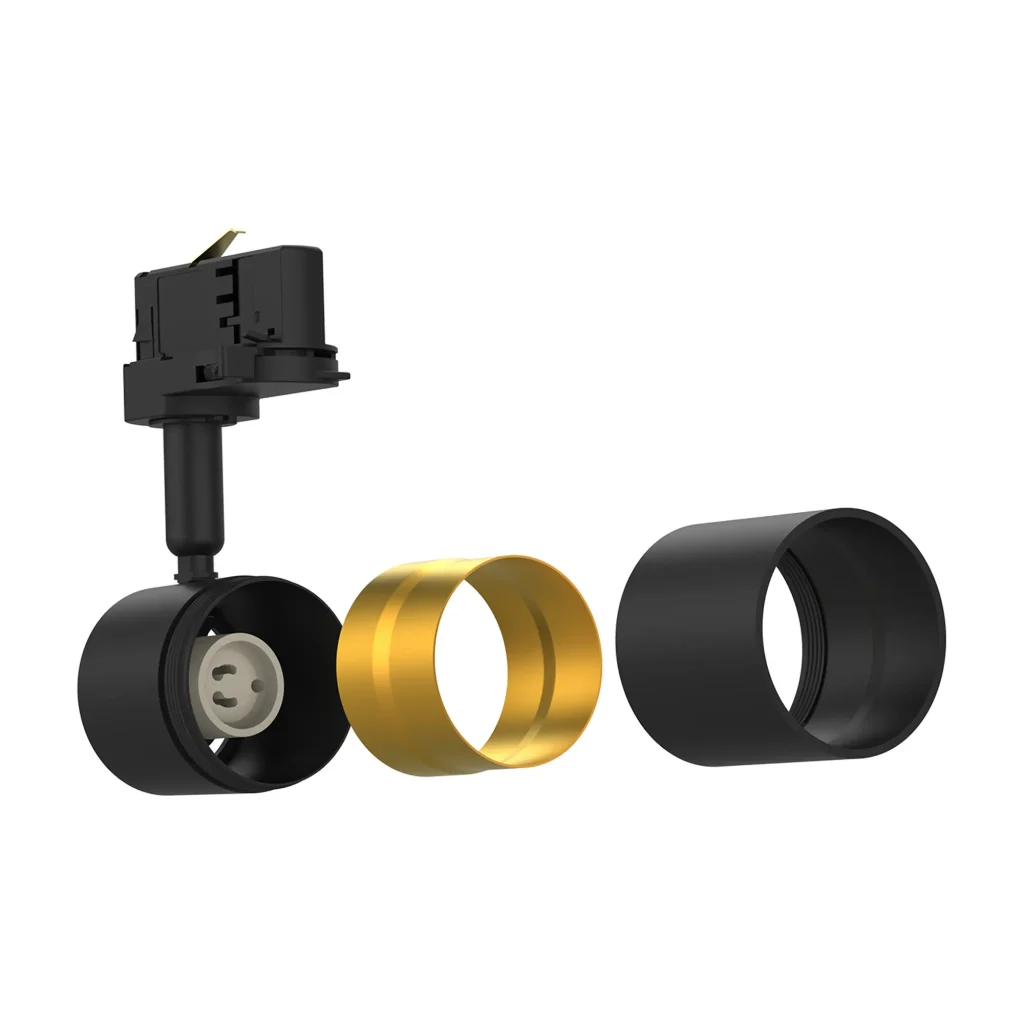
Yet many brands and project-based buyers discover a frustrating reality during development:
- The LED chip selection is reasonable
- The driver choice is acceptable
- Optical components are well specified
- But the final luminaire quality is dragged down by the housing
This is why users searching for cylinder downlight housing manufacturer are rarely looking for a simple metal supplier. What they are actually trying to solve is this:
How do we find a manufacturer that understands aluminum processing and the real demands of commercial lighting applications?
At this stage, housing selection stops being a purchasing task and becomes a strategic decision.
2. What Is an Aluminum Cylinder Downlight Housing?
In commercial lighting, a housing is never just a shell.
Housing as a Structural System
An aluminum cylinder downlight housing typically integrates multiple critical functions:
- Structural support for LED modules and drivers
- The primary heat dissipation path
- The mechanical base for optics and anti-glare accessories
- The visible surface that defines product perception
From a system perspective, the housing determines whether all other components can perform as intended.
Why It Matters More Than Many Expect
While LEDs and drivers are often upgraded over time, the housing:
- Locks in mechanical tolerances
- Fixes thermal behavior
- Defines long-term reliability
In commercial applications, its role is closer to:
“The component that defines the lower limit of product performance.”
An aluminum cylinder downlight housing is the core manufacturing component that determines stability, lifespan, and perceived quality of a cylinder luminaire.
3. Why Aluminum Cylinder Housings Became the Industry Standard
This is not a trend—it is a result of material physics and manufacturing reality.
Key Advantages of Aluminum
- High thermal conductivity, essential for LED longevity
- Excellent machinability for precise geometries
- Broad surface finishing options
- Long-term dimensional stability
According to general material properties summarized in
Wikipedia’s overview of aluminum, aluminum combines lightweight structure with strong thermal and mechanical performance—qualities critical for lighting applications.
Aluminum vs Alternative Materials
| Material Type | Thermal Stability | Precision Machining | Long-Term Reliability |
|---|---|---|---|
| Plastic | Laag | Beperkt | Poor at high power |
| Composite materials | Medium | Inconsistent | Application-dependent |
| Aluminum | Hoog | Uitstekend | Commercial-grade |
For mid- to high-end commercial projects, aluminum is not an upgrade—it is the baseline expectation.
4. How Cylinder Downlight Housing Directly Affects Luminaire Performance
This is the most critical section for OEM and project buyers.
4.1 Thermal Performance
Heat generated by LEDs and drivers must be dissipated efficiently. Housing design directly influences:
- Junction temperature
- Lumen depreciation
- Driver lifespan
Poor thermal paths lead to early failure regardless of LED quality.
4.2 Optical Consistency
Housing precision affects:
- LED positioning
- Optic alignment
- Beam uniformity
Even small tolerance deviations can create visible inconsistencies in multi-luminaire installations.
4.3 Mechanical Stability
Wall thickness, rigidity, and internal structure determine:
- Installation stability
- Resistance to vibration
- Long-term alignment
4.4 Perceived Quality
Surface finish quality strongly influences brand perception—especially in visible cylinder luminaires.
For OEM and project clients, housing failure leaves no room for correction at the luminaire level.
5. Five Core Capabilities That Define a Reliable Housing Manufacturer
This section is intentionally highly selective.
1️⃣ Aluminum Processing Capability
A qualified manufacturer must master:
- Extrusion for scalable profiles
- CNC machining for precision details
- Spinning for seamless cylindrical forms
2️⃣ Thermal Structure Design Experience
Heat sink geometry, fin layout, and internal airflow are not generic—they must be designed for lighting.
3️⃣ Tolerance Control
Consistent inner and outer diameters are critical for:
- Optical compatibility
- Batch-to-batch consistency
4️⃣ Surface Finishing Consistency
Whether powder coating or anodizing, surface treatment must remain stable across production runs.
5️⃣ Lighting Application Understanding
The most important factor:
Knowing how the housing will be used in real luminaires and real projects.
Key reminder:Being good at aluminum machining does not automatically mean being good at lighting housings.
6. What a “Qualified” Aluminum Cylinder Housing Manufacturer Usually Has
Beyond claims, look for tangible capabilities:
- In-house aluminum processing or stable long-term partners
- Proven mold development and lifecycle management
- Ability to support multiple diameters and heights as a series
- Familiarity with recessed, surface-mounted, and pendant installations
- Experience supporting commercial lighting projects
- Demonstrated batch consistency over time
These capabilities reduce risk across the entire product lifecycle.
7. Why Housing Manufacturers Must Be Involved Early in OEM / ODM Projects
In many failed projects, housing decisions are made too late.
Why Early Involvement Matters
- Housing geometry defines thermal performance
- Structural decisions affect cost and assembly efficiency
- Late changes are expensive and disruptive
OEM Perspective
For private-label and OEM projects:
The housing manufacturer is not a subcontractor—it is part of the product design team.
Early collaboration enables:
- Thermal optimization
- Cost control
- Improved assembly yield
If you are developing complete luminaires such as
LED-spotdownlights
or architectural cylinders within broader
Commercial Lighting Solutions,
housing decisions should never be an afterthought.
8. Common Mistakes When Sourcing Cylinder Downlight Housings
These mistakes are repeatedly seen in OEM and project markets.
Typical Pitfalls
- Choosing by unit price only
- Ignoring tolerance and repeatability
- Approving samples but failing to control mass production
- Frequently switching housing suppliers
- Treating housings as interchangeable components
Reminder:
A wrong housing choice amplifies risk across the entire luminaire.
9. Different Housing Requirements Across Commercial Applications
Not all projects demand the same priorities.
| Application Type | Key Housing Requirements |
|---|---|
| Retail & display | Visual consistency, glare control integration |
| Offices & public spaces | Thermal stability, long operating hours |
| Premium projects | Surface finish quality, precision details |
| OEM private label | Expandable series design, standardization |
A capable manufacturer understands these differences and adapts accordingly.
10. FAQ About Cylinder downlight housing manufacturer
Q1: Is aluminum always better than plastic for downlight housings?
In commercial lighting, almost always yes.
Q2: CNC vs extrusion—how do I choose?
It depends on design complexity and production volume.
Q3: Does surface finishing significantly affect cost?
Yes, but it has an even greater impact on brand perception.
Q4: Should housing design consider certifications early?
Absolutely. Structure influences luminaire compliance.
Q5: Is aluminum housing suitable for long-term OEM cooperation?
Yes—when the manufacturer is stable and consistent.
11. Conclusion
In cylinder downlights, housing quality defines the performance baseline.
Aluminum housings have become the standard because they support:
- Thermal stability
- Structural precision
- Long-term reliability
A reliable aluminum cylinder downlight housing manufacturer can:
- Improve product lifespan
- Reduce after-sales risk
- Support scalable product families
For brands and project buyers, this is not a single purchase decision—it is a supply chain commitment.
Final takeaway:Choosing an aluminum cylinder downlight housing manufacturer is ultimately a choice about long-term product reliability.
Welcome to collaborate
If you are evaluating or developing cylinder downlights and want to ensure that housing design, thermal performance, and manufacturability are aligned from the start, the next step is usually early technical coordination.
If you would like support reviewing housing concepts, matching them with optics and drivers, or building a scalable OEM-ready luminaire platform, you can
👉 request a project-based lighting consultation and share your basic requirements.
This approach helps transform individual components into a coherent, long-term lighting product strategy—rather than solving issues after production begins.