 XHLUX
XHLUX
Table of contents
In architectural and commercial lighting design, ceiling spotlights remain a preferred solution for precise, controllable illumination. Project managers and designers often face one key decision: should I specify single or double recessed spotlights?
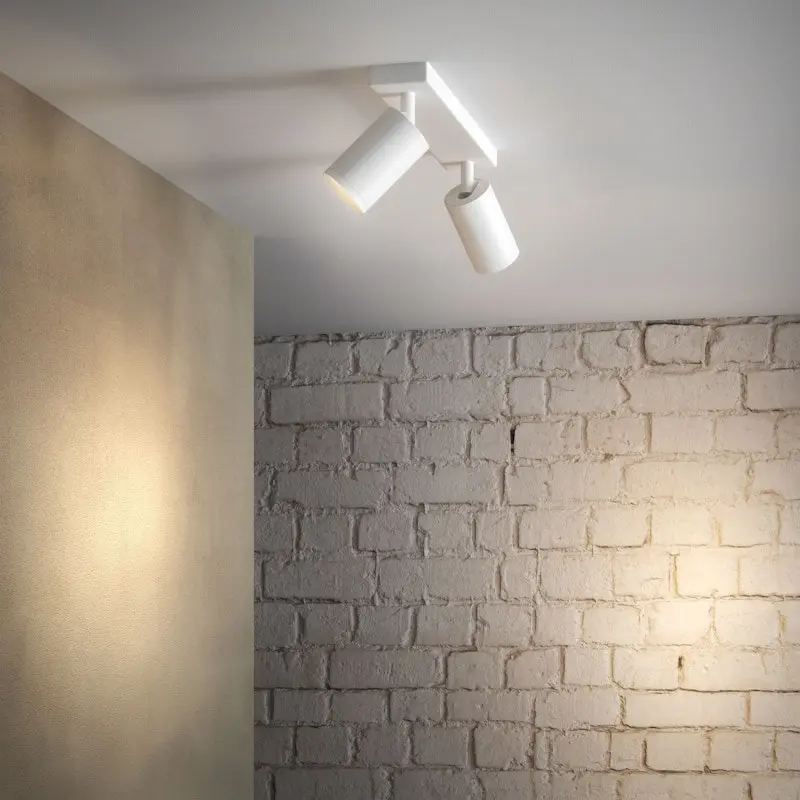
Both options deliver focused beams and sleek aesthetics, but they differ in beam control, energy performance, and visual impact.This guide explains how each type works, where they excel, and how to select the ideal option for your lighting project.
1 Definition & Core Differences
| Feature | Single Spotlight Ceiling | Double Spotlight Ceiling |
|---|---|---|
| Number of Light Sources | One optical head | Two independently adjustable heads |
| Beam Control | Fixed or semi-adjustable | Flexible—each head can rotate & tilt |
| Cut-out Size | Smaller aperture (55–90 mm) | Larger cut-out (90–150 mm) |
| Purpose | Accent / task lighting | Broader coverage or dual-zone lighting |
A single spotlight offers a minimalist appearance and concentrated illumination, ideal for highlighting artwork or merchandise.
A double spotlight integrates two modules into one housing, enabling designers to create layered light from a single fixture position—reducing ceiling clutter and installation time.
2 Brightness & Coverage Comparison
Lighting output varies by chip efficacy and optical design rather than simply the number of heads.
Below is an indicative performance chart for 10 W COB (single) versus 2 × 7 W COB (double) spotlights.
| Metric | Single Spotlight | Double Spotlight |
|---|---|---|
| Total Luminous Flux | ~900 lm | ~1 800 lm |
| Beam Angle Options | 15° / 24° / 36° | Independent 24° + 36° possible |
| Average Illuminance (1 m) | 580 lx | 2 × 450 lx (combined 900 lx +) |
| Uniformity Ratio | 0.55 | 0.75 – 0.8 |
Interpretation:
- Double units increase total lumens and improve uniformity.
- Single units provide higher contrast and visual drama.
💡 Tip: For retail shelves or gallery walls, combine several singles for spotlight rhythm; for corridors or lobbies, choose doubles to minimize fixture count.
Long-tail terms: beam spread comparison, lumen efficiency chart, lighting performance data.
3 Installation & Application Scenarios
Installation Styles
- Recessed-Trim or Trimless Mounting – both types integrate seamlessly into gypsum ceilings.
- Surface-Mounted Casings – suitable for concrete ceilings or retrofit projects.
- Adjustable Gimbal Types – allow ±30° tilt for flexible aiming.
Typical Applications
| Space | Recommended Type | Rationale |
|---|---|---|
| Residential Living Area | Single | Focused ambience & compact layout |
| Hotel Corridor | Double | Continuous lighting with fewer fixtures |
| Showroom Display | Double | Two-zone beam highlighting |
| Art Gallery / Museum | Single | Precise accent & reduced glare |
| Retail Storefront | Mix | Singles for products, doubles for ambient wash |
Include project photos showing uniform ceiling layouts and contrast lighting schemes.
4 Energy Efficiency and Lifecycle Cost
| Parameter | Single Spotlight | Double Spotlight |
|---|---|---|
| Power Consumption | 8–15 W | 14–24 W |
| Efficacy | 95–110 lm/W | 100–115 lm/W |
| Rated Lifetime | 50 000 h | 50 000 h (shared driver) |
| Maintenance Cost | Low | Slightly higher (dual optics) |
Because both use advanced LED modules, energy efficiency differences are minimal. Doubles save installation time and wiring cost when wider coverage is required, whereas singles reduce material use for smaller rooms.
Include a bar chart comparing energy cost per year (based on 12 h/day usage at $0.12 /kWh) to visualise TCO (Total Cost of Ownership).
5 Choosing the Right Spotlight for Your Project
Follow this quick selection framework:
| Project Goal | Recommended Type | Key Specs to Check |
|---|---|---|
| High-contrast accent lighting | Single | CRI ≥ 90, beam 15° – 24° |
| Uniform corridor illumination | Double | 2 × 24° beams, glare shield |
| Budget-sensitive renovation | Single | TRIAC dimming, cost-effective driver |
| Premium hotel lobby | Double | DALI or Bluetooth control, trimless design |
Other considerations:
- UGR ≤ 19 for office or hospitality use.
- Color Temperature Options: 2700 K – 4000 K.
- Certifications: CE, RoHS, ETL ensure compliance.
🧩 Pro Tip: When specifying large projects, request LM79 / TM21 reports to verify photometric data and driver reliability.
6 Common Questions About Double and Single Spotlights
Q1 : Are double spotlights twice as bright as single ones?
Not exactly—brightness depends on wattage and optics. Two 7 W heads ≈ 1.8× a single 10 W fixture, not double.
Q2 : Can single and double spotlights mix in one project?
Yes. Many designers combine them to achieve accent + ambient layering.
Q3 : Do both types support dimming?
Modern LED drivers offer TRIAC, 0-10 V, or DALI dimming for both. Verify compatibility with your control system.
Q4 : Which type gives better energy savings?
They are similar in lm/W. Savings depend on layout density and operating hours.
Q5 : Are double spotlights harder to maintain?
Slightly—two modules mean two lenses and reflectors to clean, but maintenance cycles remain 1–2 years under normal use.
7 Conclusion
Both single and double recessed spotlights deliver professional-grade illumination when correctly specified.
Singles highlight detail and elegance; doubles provide flexibility and efficiency across larger spaces.
Need expert advice?
Our team designs and manufactures OEM / ODM LED spotlight solutions for commercial, hospitality, and architectural projects worldwide.Contact Us for a free photometric layout or custom quotation.