 XHLUX
XHLUX
![ما هو ضوء المسار القابل للتعتيم للمعرض: أفضل دليل [2025]](https://xhlux.com/wp-content/uploads/2024/05/news.webp)
جدول المحتويات
- The Four Pillars of Professional Gallery Lighting
- Deep Dive: Building Your Ideal Gallery Track Light System
- Choosing Your Control System: DALI vs. Wireless Professional Systems
- Lighting Techniques for Different Media: Paintings vs. Sculptures
- FAQ About Dimmable Track Lighting for Gallery
- The State of Gallery Lighting in 2025: Trends and Insights
- Your Lighting is Your Most Important Curatorial Tool
Lighting an art gallery is a profound responsibility. It is a delicate balance between revelation and preservation. The goal is to present a piece of art in its most honest, impactful form, just as the artist intended, while simultaneously protecting that same piece for future generations to experience. In this high-stakes environment, generic lighting simply will not do.
The modern solution, trusted by curators and designers worldwide, is a professional-grade Dimmable Track Light for Gallery applications. But this is not just any track light. It is a specialized system, a precision tool where every component and every feature is chosen with purpose.
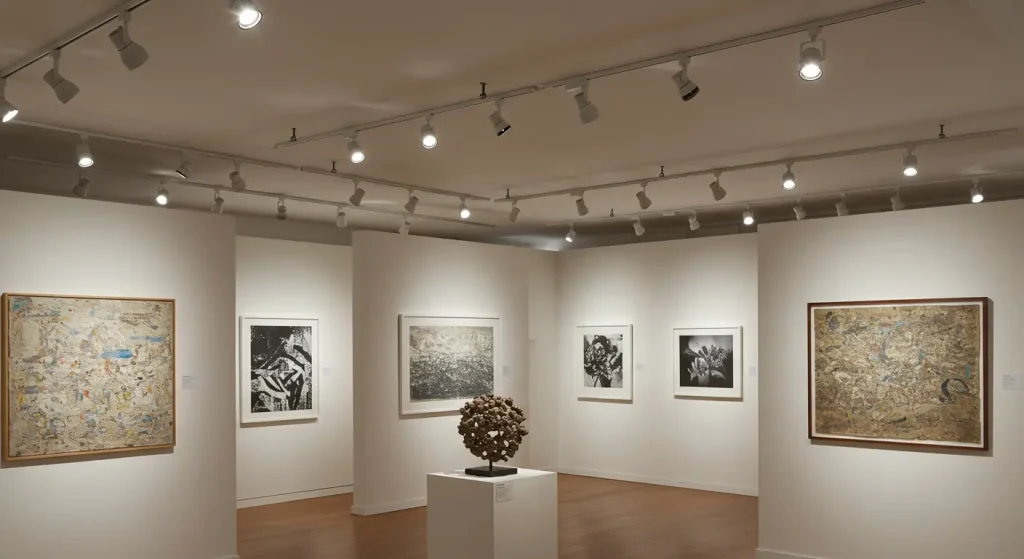
So, what are the non-negotiable features of a true gallery-quality lighting system? How do you ensure you are revealing every nuance of color while preventing damage? And how do you build a system that is flexible enough to adapt to an ever-changing rotation of exhibits?
The Four Pillars of Professional Gallery Lighting
For a lighting system to be considered “gallery-grade,” it must excel in four distinct areas. If you are planning or upgrading your space, these are your non-negotiable pillars of quality.
- Uncompromising Light Quality (CRI 95+): The light must render color with absolute fidelity. The artist’s palette must be seen precisely as it was created.
- Absolute Control over Intensity (Precision Dimming): The ability to dim smoothly and accurately is critical not just for mood, but for art conservation.
- Unmatched Flexibility (Track & Optics): Exhibits change. The lighting system must be able to adapt effortlessly to new artworks of different sizes and in different locations.
- Total Visual Comfort (Superior Glare Control): The focus must be on the art, not on a distracting or uncomfortable light source. The lighting should be invisible in its effect.
A true Dimmable Track Light for Gallery settings is one that masters all four of these pillars. Let’s explore how.
Deep Dive: Building Your Ideal Gallery Track Light System
Achieving professional results means understanding the technology behind each of the four pillars.
Pillar 1: The Pursuit of True Color (CRI 95+ & High R9)
This is the most important pillar. The human eye perceives color based on the spectrum of light that reflects off an object. If the light source is missing parts of the spectrum, you will never see the true color of the art.
- Color Rendering Index (CRI): For general use, a CRI of 90+ is considered excellent. For a gallery, it is merely the starting point. You must specify fixtures with a CRI of 95 or higher. This ensures that the vast majority of colors are rendered with near-perfect accuracy.
- The Crucial R9 Value: Standard CRI averages 8 pastel colors, but the R9 value specifically measures the rendering of saturated red. This is vital for art, as reds are present in everything from skin tones and textiles to bold abstract works. A low R9 value will make reds appear dull or brownish. For any serious gallery, look for a high R9 value, ideally 85 or higher, alongside the CRI 95+ rating. This is a hallmark of true museum quality track lighting.
- TM-30: This newer, more comprehensive color rendering metric provides even more data. Seeing TM-30 metrics on a spec sheet is a sign of a manufacturer committed to the highest standards of light quality.
Pillar 2: The Science of Preservation (Dimming for Conservation)
Light, while essential for viewing art, is also a source of radiant energy that causes cumulative, irreversible damage over time. Fading pigments and degrading materials are a direct result of overexposure to light. This is where precision dimming becomes a critical conservation tool.
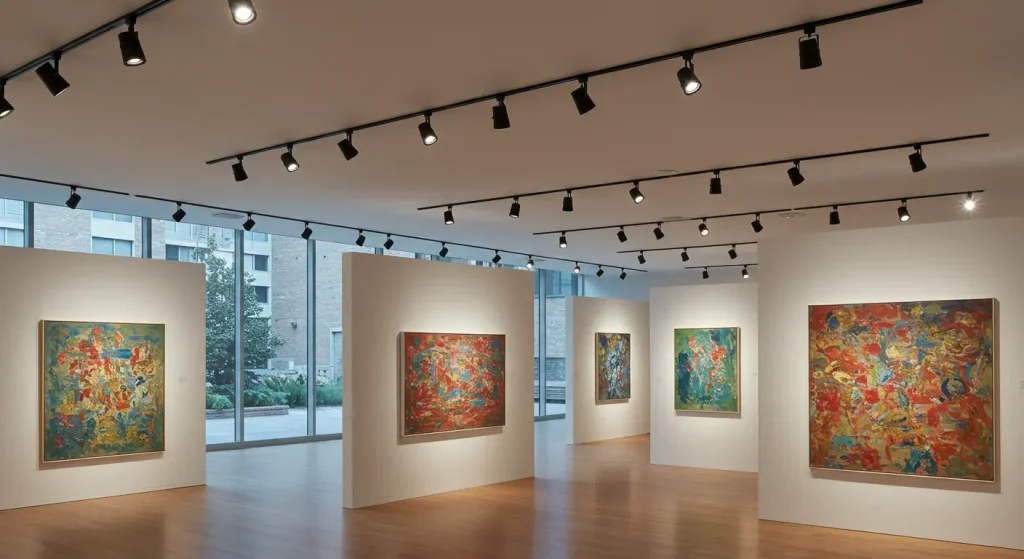
- Controlling Lux Levels: Conservation standards, like those from the Getty Conservation Institute or the IES, recommend strict limits on the amount of light (measured in lux) that different types of art should be exposed to. For example, highly sensitive materials like textiles or watercolors may have a limit of 50 lux, while oil paintings might tolerate 150-200 lux.
- The Role of Dimming: A professional-grade dimmable system allows you to dial in the exact lux level required for each piece of art. Using a handheld light meter, you can aim a spotlight, measure the light falling on the artwork, and dim the fixture down until you hit the precise, safe level. Smooth, flicker-free dimming from 100% down to 1% or even 0.1% is a key feature to look for.
Pillar 3: The Art of Focus (Track Systems & Adjustable Optics)
A gallery is a dynamic space. A system that is perfect for one exhibition must be perfectly adaptable for the next.
- The Track Infrastructure: A multi-circuit track system (like a 3-circuit track light) allows you to have different layers of light (e.g., general wall wash on one circuit, specific accents on another) controlled independently. Modern إضاءة مسار منخفضة الجهد offer the added benefit of effortless, tool-free repositioning of fixtures.
- Adjustable Optics (Zoomable Fixtures): A zoomable dimmable track light is the ultimate tool for a flexible gallery. A single fixture with an adjustable beam angle (e.g., from 10° to 50°) can be used to perfectly frame a tiny sculpture one day and a large canvas the next. This eliminates the need for a large inventory of different fixed-beam fixtures and provides unparalleled adaptability.
- Framing Projectors: For the highest level of control, a contour framing projector allows you to shape the beam into a precise square or rectangle, illuminating a painting right to its edges with zero light spill.
Pillar 4: Eliminating Distractions (Advanced Glare Control)
The goal is for visitors to be captivated by the art, not annoyed by the lighting. Superior glare control is what makes the lighting disappear.
- Deep-Set LED sources: The light source must be deeply recessed within the fixture housing to shield it from direct view.
- High-Quality Optics: Precision lenses and reflectors create a clean beam with a sharp cut-off and minimal light spill.
- Accessories are Key: A track light with a honeycomb louver is the industry standard for minimizing glare on accent lights. Snoots and baffles can further shape the beam and conceal the source.
Choosing Your Control System: DALI vs. Wireless Professional Systems
For a gallery, simple on/off switches or basic wall dimmers are insufficient. You need a system that offers granular, reliable, and repeatable control.
| Control System | How It Works | الأفضل لـ | Pros | Cons |
|---|---|---|---|---|
| DALI (Wired) | A dedicated two-wire data bus connects all fixtures to a central controller. Each fixture has a unique digital address. | New builds or major renovations where ultimate reliability and building integration are key. | Extremely reliable; provides status feedback; industry standard for commercial control. | Requires dedicated control wiring; more complex to commission. |
| Casambi (Wireless) | Fixtures with Casambi technology form a decentralized Bluetooth Low Energy mesh network. Controlled via an app. | Retrofits, historic buildings, or any space where running new control wires is difficult or undesirable. | No control wires needed; highly flexible and scalable; intuitive app-based commissioning. | Does not have the hardware-level feedback of DALI; reliability depends on the mesh network. |
A DALI controlled gallery lighting system is often considered the gold standard for new construction, while Casambi offers a powerful and increasingly popular wireless alternative, especially for existing spaces.

Lighting Techniques for Different Media: Paintings vs. Sculptures
Your choice of fixture and technique should adapt to the art itself.
- Lighting Paintings: The goal is even illumination across the entire surface. This is often achieved with two track lights aimed at the painting from a 30-degree angle to minimize veiling reflections (glare off the surface of the painting) and shadows from the frame. A framing projector is the ideal tool here.
- Lighting Sculptures: Sculpture is about form and texture. It often requires multiple light sources from different angles to reveal its three-dimensional nature. A key light provides the main illumination, a fill light softens shadows, and a back light helps to separate the sculpture from its background. The flexibility of a track system is essential for this multi-angle approach.
FAQ About Dimmable Track Lighting for Gallery
The State of Gallery Lighting in 2025: Trends and Insights
The museum and gallery sector is a leader in adopting high-quality lighting technology. The trend is moving firmly towards fully integrated, smart systems. Curators and facility managers are demanding not just excellent light quality, but also data and control. They want to monitor energy usage, track luminaire performance for proactive maintenance, and easily reconfigure entire museum wings from a central tablet. This drive towards smart, flexible, and conservation-focused lighting ensures that advanced dimmable track light for gallery systems will remain a critical area of innovation.
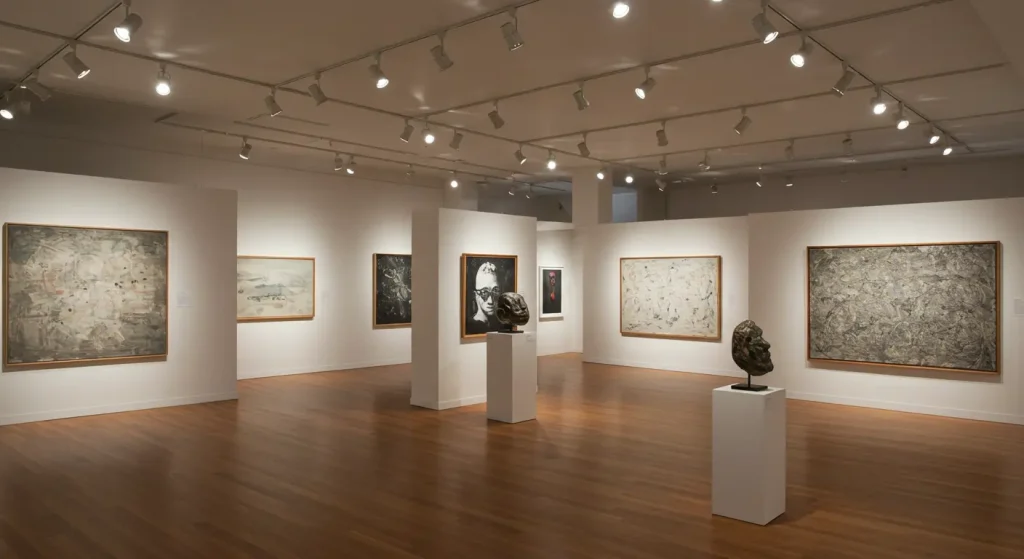
Your Lighting is Your Most Important Curatorial Tool
Is a professional-grade Dimmable Track Light for Gallery use an essential investment?
For any serious gallery, museum, or art collector, the answer is an absolute, unequivocal yes.
The right lighting system is not an expense; it is a fundamental part of the gallery’s mission. It is the tool that allows art to communicate its full power, a guardian that protects it from harm, and a flexible platform that enables dynamic and engaging curation. To compromise on lighting is to compromise on the art itself. By investing in a system that masters the four pillars—Light Quality, Intensity Control, Flexibility, and Visual Comfort—you are investing in the best possible experience for your visitors and the best possible care for your collection.
Your collection is priceless. It deserves to be seen perfectly.
Specifying a lighting system for a gallery is a complex and critical task. If you are ready to design a solution that meets the exacting standards your artwork deserves, our team of lighting specialists is here to provide the expert consultation you need.
Contact us today to discuss your project, and let us help you illuminate your collection with brilliance and care.