 XHLUX
XHLUX

جدول المحتويات
- 1. Why Bakery Lighting Directly Decides “Will It Sell?”
- 2. What Is a Bakery & Pastry Specialized LED Downlight?
- 3. Why Ordinary Commercial Downlights Often Ruin Bakery Presentation
- 4. How Specialized LED Spectrum Improves Bakery & Pastry Visual Results
- 5. Why LED Downlights Are Often the Best Fixture Type for Bakery Zones
- 6. Category-Specific Effects in Bakery Displays
- 7. Specialized Bakery Downlights vs General Lighting
- 8. How to Choose Bakery Lighting LED Downlights
- A Practical “Commercial-Grade” Checklist
- 8.1 Spectrum: Must Be Bakery-Optimized (Not Just “Warm White”)
- 8.2 High Color Quality: Use Ra97 / CRI>90 as a Baseline
- 8.3 Tight Color Consistency: SDCM < 3
- 8.4 Glare Control: Anti-Glare Optics Are Non-Negotiable
- 8.5 Efficiency Band: 100–130 lm/W (Project Planning Range)
- 8.6 Lifetime and Reliability: L70/B50 50,000 Hours
- 8.7 Thermal and Materials (Spec-First Rule)
- 8.8 Dimming & Controls: DALI / DALI-2 / 0–10V / Phase-cut
- 8.9 Easy Installation + ODM Customization
- 9. Data Tables You Can Use in Real Bakery Projects
- 10. Common Mistakes in Bakery Lighting (And How to Avoid Them)
- Comparison Table Specialized Bakery Downlights vs Standard Commercial Downlights
- FAQ About Bakery lighting LED downlights
- Why Specialized LED Downlights Are a Rational Bakery Lighting Upgrade
- Business collaborations are welcome
1. Why Bakery Lighting Directly Decides “Will It Sell?”
Bread, cakes, and pastries are some of the most visually driven products in any supermarket or bakery shop. Shoppers rarely “test” before they buy. They decide with their eyes—fast.
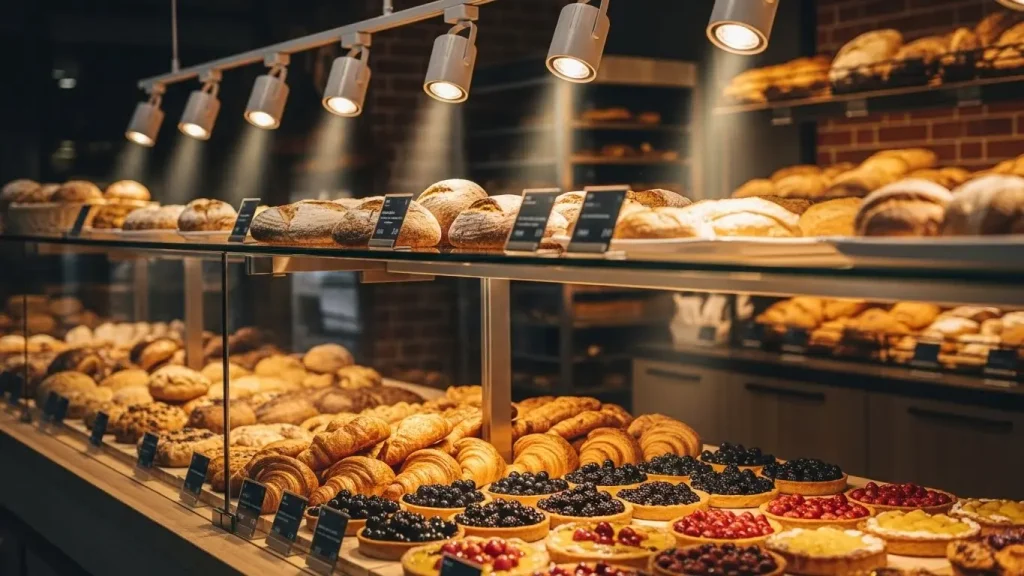
In real stores, customers don’t say “the CRI is low.” They say:
- “This bread looks a bit old.”
- “That cake looks dull.”
- “The cream looks pale.”
Even if your products are genuinely fresh, the wrong lighting can make them look:
- gray (bread crust loses warmth)
- dark (pastry layers lose detail)
- chalky (cream and frosting lose texture)
That is why people searching bakery lighting LED downlights are not looking for “a downlight.” They’re asking:
How do we use lighting to display the most appetizing, fresh-baked side of bakery products—without making food look fake?
The most reliable answer is a specialized bakery/pastry LED downlight: a downlight optimized in spectrum + optics + glare control + stability specifically for baked goods.
2. What Is a Bakery & Pastry Specialized LED Downlight?
A “specialized” bakery downlight is not just a standard commercial downlight with a warm CCT label.
What “Specialized” Really Means
It typically includes:
- A food-optimized spectrum
Not generic white light. The spectrum is tuned to emphasize the warm tones that communicate “fresh-baked” (golden crust, caramelization, chocolate depth), while keeping creams and lighter toppings natural. - Optical control built for display
Bakery is full of reflective surfaces: glass cases, glossy pastries, icing, packaging. Specialized downlights prioritize controlled cut-off and accessories (deep baffle / honeycomb), so shoppers see food—not the LED source. - Commercial-grade stability for long hours
Bakery areas run long hours daily. A proper solution is engineered for heat management, consistency, and repeatability.
One-sentence definition:A bakery LED downlight is a retail-grade downlight engineered to enhance the color, texture, and “freshness perception” of bread and pastry displays through optimized spectrum and controlled optics.
When this is applied correctly, your bakery lighting stops being “just illumination” and becomes a merchandising amplifier.
3. Why Ordinary Commercial Downlights Often Ruin Bakery Presentation
This is the root cause section—the reason bakery lighting fails even when the store looks “bright.”
3.1 Bakery Colors Live in the Warm Zone
Baked goods rely heavily on:
- amber / golden crust tones
- warm browns (caramel, chocolate, toasted pastry)
- soft creams (vanilla, whipped cream, frosting)
Generic commercial lighting often shifts these tones in unhelpful ways.
3.2 Typical Failure Patterns of Standard Downlights
Common problems in bakery zones:
- Too cool: bread crust looks pale, pastry looks “cold”
- Weak warm rendering: browns look flat, chocolate loses depth
- Cream turns chalky: frosting looks white and lifeless
- Gloss disappears: glaze and texture look dull
This is why “high CRI” alone is not a guarantee. The CIE itself notes CRI has limitations—especially with solid-state (LED) light sources, where numeric Ra values don’t always match visual evaluations.
Core takeaway:High CRI ≠ bakery-optimized. Spectrum intent matters.
4. How Specialized LED Spectrum Improves Bakery & Pastry Visual Results
This is the most conversion-driven section, because it links lighting decisions to what customers actually see.
4.1 Stronger “Fresh-Baked Warmth” Without Looking Artificial
Specialized bakery spectra typically:
- support amber/golden tones (crust, flaky layers)
- keep browns rich but not muddy
- reduce the “cold dilution” effect that happens when blue-heavy light washes warm food
Many food-display guides recommend warm-white ranges for baked goods because they reinforce “warm-toned foods like pastries and breads.”
4.2 Better Texture Visibility: Layers, Flakes, Crust, Filling
Bakery products sell on texture:
- laminated pastry layers
- crisp crust micro-contrast
- cream smoothness
- chocolate sheen
A well-tuned spectrum plus controlled optics improves perceived texture and makes products look more premium.
4.3 More Natural Creams and Frostings (The “Truth Test”)
The hard part of bakery lighting is balancing:
- warm tones for bread
- but still keeping creams clean and not yellow/dirty
A specialized spectrum aims for appetizing realism, not “Instagram filters.”
One-sentence summary:Good bakery lighting makes everything look freshly baked—without crossing into fake-looking saturation.
5. Why LED Downlights Are Often the Best Fixture Type for Bakery Zones
Bakery lighting needs to be strong on display performance, but clean in architecture.
5.1 Focused Light Where the Product Is
Downlights can concentrate light on:
- countertop displays
- wall shelving
- island feature tables
- inside/perimeter of bakery zones in supermarkets
5.2 Clean Ceiling, Low Visual Clutter
Compared with track lighting, downlights keep ceilings quieter—especially important in supermarkets where signage, HVAC, and ceiling grids already compete visually.
5.3 Lower Heat Load Near Food
High-quality LED systems keep heat much lower than legacy sources, helping maintain the desired bakery environment.
5.4 Easy Integration with Joinery and Display Layout
Downlights fit well with bakery counters, soffits, and perimeter ceiling features—making them easier to standardize across chain stores.
If your bakery is part of a larger retail store, downlights typically work together with:
- LED Linear Lighting for aisles and circulation
- LED Track Lighting for seasonal feature displays
- LED Spot Downlights for premium accent on hero products
6. Category-Specific Effects in Bakery Displays
Different bakery categories respond differently to light. This is why “one light for everything” underperforms.
6.1 Bread (Baguette, Artisan, Sourdough)
Lighting goals:
- crust looks golden and crisp
- scoring lines show texture
- avoid “gray bread” perception
Result when done right:
- bread appears warm, fresh, and fragrant—even visually.
6.2 Cakes & Pastries
Lighting goals:
- layered structure becomes readable
- fruit toppings look vivid but natural
- glaze and icing regain gloss
6.3 Cream and Frosting Products
Lighting goals:
- cream looks smooth, soft, and clean
- avoid chalky white or overly yellow tones
6.4 Chocolate & Dark Desserts
Lighting goals:
- keep depth and detail
- avoid “black hole” effect where texture disappears
6.5 “Fresh Out of the Oven” Zone
Lighting goals:
- reinforce warmth and freshness
- create a visual focal point that pulls traffic
7. Specialized Bakery Downlights vs General Lighting
The Business Decision Logic (Not Just Specs)
A bakery display is a conversion surface. The lighting is part of the merchandising investment.
General Lighting Approach
- lower fixture cost
- but limited ability to enhance food presentation
- often leads to slow-moving displays (“looks okay, doesn’t excite”)
Specialized Bakery Downlight Approach
- used in bakery zone only (targeted)
- designed to increase appetite appeal and perceived freshness
- supports premium positioning and higher basket confidence
Retail logic:Lighting is part of the display strategy, not just part of the renovation.
8. How to Choose Bakery Lighting LED Downlights
A Practical “Commercial-Grade” Checklist
This section is designed for decision-makers: designers, contractors, wholesalers, supermarket operators.
8.1 Spectrum: Must Be Bakery-Optimized (Not Just “Warm White”)
Warm CCT helps, but spectrum design matters. Many guides recommend warm ranges (often 2700–3000K) for baked goods, with some guidance also discussing 4000K use cases for certain frosted displays depending on the presentation intent.
Best practice: sample in-store with real products.
8.2 High Color Quality: Use Ra97 / CRI>90 as a Baseline
For premium bakery zones, treat Ra97 (CRI97) as the preferred target and CRI>90 as the minimum for serious presentation.
Also remember: CRI describes color fidelity relative to a reference illuminant, and it’s determined by spectrum (not by CCT).
8.3 Tight Color Consistency: SDCM < 3
In bakery displays, small color differences between fixtures become obvious—especially along long counters or repeated ceiling patterns. SDCM < 3 is a practical commercial target.
8.4 Glare Control: Anti-Glare Optics Are Non-Negotiable
Bakery zones have glass cases, glossy glazes, and polished counters. Without glare control:
- customers see reflections
- products lose texture
- the zone feels cheap and uncomfortable
بحث:
- deep recess design
- optional honeycomb louver
- controlled cut-off optics
(UGR is formally measured for installations and is often referenced in workplaces; UGR targets like ≤19 are common in office standards discussions, which reinforces how important glare control is for comfort generally. (nvcuk.com))
8.5 Efficiency Band: 100–130 lm/W (Project Planning Range)
For commercial downlights, 100–130 لومن/واط is a practical planning band when balancing optics + glare control + high color quality.
8.6 Lifetime and Reliability: L70/B50 50,000 Hours
Bakery zones run daily. Treat L70/B50 50,000 ساعة as a baseline expectation for commercial-grade reliability.
8.7 Thermal and Materials (Spec-First Rule)
A serious bakery downlight should be engineered like a commercial product:
- Die-cast aluminum heatsink (thermal stability)
- رقائق COB light engine (clean beam control)
- عدسة PMMA optics (stable retail optics performance)
8.8 Dimming & Controls: DALI / DALI-2 / 0–10V / Phase-cut
Bakery lighting often benefits from:
- daytime vs evening tuning
- reducing glare during low-traffic hours
- scene control for “fresh-out-of-oven” focal moments
For protocol background, use:
8.9 Easy Installation + ODM Customization
For chain rollout and wholesalers:
- easy installation reduces labor risk
- ODM options (beam angles, trim colors, accessories) support brand identity
If you need a system-level approach (bakery + aisles + fresh food zones), start from حلول الإضاءة instead of selecting one SKU in isolation.
9. Data Tables You Can Use in Real Bakery Projects
Table A — Recommended Lighting Goals by Bakery Category
| فئة | Visual Goal | What the Downlight Must Do |
|---|---|---|
| Artisan bread | golden crust + crisp texture | warm-balanced spectrum + clean beam |
| Pastry & layered desserts | layer clarity + gloss | high fidelity + controlled glare |
| Cream cakes | smooth, soft, natural cream | avoid chalky whites + avoid dirty yellow |
| Chocolate desserts | depth + detail | prevent dark flattening + maintain texture |
| Fresh-baked zone | “just out of oven” emotion | warm focal lighting + comfortable viewing |
Table B — “Commercial-Grade Bakery Downlight” Procurement Baseline
| غرض | Suggested Baseline |
|---|---|
| Color quality | CRI>90, premium target Ra97 / CRI97 |
| Color consistency | SDCM < 3 |
| Efficiency planning | 100–130 لومن/واط (depending on optics + CRI) |
| Lifetime | L70/B50 50,000 hrs |
| Thermal design | Die-cast aluminum heatsink |
| بصريات | عدسة PMMA + anti-glare options |
| Light engine | رقائق COB |
| Controls | DALI / DALI-2 / 0–10V / phase-cut |
| Project readiness | IES files + cut sheets + install guide |
| التخصيص | beam angles, trims, accessories, ODM |
Table C — Common “Wrong Light” Symptoms and Fast Fixes
| What You See in Store | Likely Cause | What to Change |
|---|---|---|
| bread looks gray | spectrum too cool / weak warm rendering | bakery-optimized warm spectrum |
| cream looks chalky | poor spectrum balance + glare | higher fidelity + anti-glare optics |
| pastries look flat | wrong beam / glare reflections | better optics + beam angle tuning |
| chocolate looks dull | low fidelity + over-wide flooding | tighter beam + improved color quality |
10. Common Mistakes in Bakery Lighting (And How to Avoid Them)
Mistake 1: Using Cool White for Bakery
Cool white can make baked goods look sterile and reduce golden warmth. Use warm-balanced bakery lighting where appropriate.
Mistake 2: “One Lighting SKU for the Whole Store”
Bakery and pastry displays are not the same as aisles, dairy, or seafood. Zone-specific lighting wins.
Mistake 3: Only Checking CRI, Not Spectrum Intent
CRI is a useful metric, but it has known limitations with LED sources; visual performance should be validated with samples and (when available) advanced metrics like TM-30. (cie.co.at)
Mistake 4: Ignoring Glare Because “It’s Bright Enough”
Brightness doesn’t equal quality. Glare kills appetite appeal.
Mistake 5: Treating Bakery Lighting as “Done Once”
Stores change: seasonal lines, promotions, new packaging. Your lighting strategy should be repeatable and adjustable.
Comparison Table Specialized Bakery Downlights vs Standard Commercial Downlights
| عامل القرار | Standard Commercial Downlight | Specialized Bakery LED Downlight |
|---|---|---|
| Spectrum intent | general-purpose | bakery-optimized (golden/amber/brown balance) |
| Visual outcome | “bright enough” | “fresh-baked + appetizing + premium” |
| Cream/frosting presentation | often chalky/flat | smoother, more natural texture |
| Glare handling in glass cases | often insufficient | designed for anti-glare accessories |
| ROI logic | fixture cost | merchandising + conversion support |
| Best use | general areas | bakery counters, pastry displays, hero shelves |
FAQ About Bakery lighting LED downlights
Q1: Do bakeries really need specialized LED downlights?
If you sell bread and pastry as visually driven products, yes—the difference is usually obvious immediately on the counter.
Q2: Will specialized bakery lighting make food look “fake”?
Not when the spectrum is designed for realistic presentation. The goal is appetite appeal without distortion.
Q3: Is CRI97 necessary for bakery?
For premium pastry and hero displays, CRI97 is often preferred. CRI>90 is a minimum baseline, but spectrum intent and glare control still matter. (维基百科)
Q4: What color temperature is best for bakery lighting?
Warm ranges (often around 2700–3000K) are commonly used to enhance baked goods, while some displays (e.g., certain frosted items) may use neutral approaches depending on the concept. Validate with samples. (HitLights)
Q5: Will bakery downlights increase energy consumption?
High color quality can slightly reduce peak efficacy versus low-CRI lighting, but in bakery zones the business goal is sales presentation and shopper response—not just lm/W.
Q6: Do I need dimming in bakery zones?
It’s strongly recommended for comfort and day/night tuning. DALI-based control is commonly used in commercial lighting control systems. (جمعية هندسة الإضاءة)
Why Specialized LED Downlights Are a Rational Bakery Lighting Upgrade
Bakery and pastry retail is driven by visual appetite. If lighting makes your products look dull, gray, or “not fresh,” you lose conversion silently—every day.
Specialized bakery LED downlights are designed to solve exactly that:
- enhance golden crust and warm pastry tones
- improve texture and gloss perception
- keep creams and frostings natural
- reduce glare in glass cases
- deliver stable performance across long operating hours
For bakeries inside supermarkets, chain stores, and premium pastry shops, this upgrade is often small in cost but fast in return because it supports what matters most: presentation and sales.
Final takeaway:Specialized bakery LED downlights exist to help bread and pastries sell better—through realistic, appetizing light.
Business collaborations are welcome
If you want a bakery lighting setup that consistently makes products look “fresh out of the oven,” the fastest path is to align on a few practical inputs:
- ceiling height + counter height
- product types (bread / pastry / cream cakes / chocolate / fresh-baked zone)
- beam angles for each display zone
- glare control level (standard vs premium glass cases)
- control method (DALI / 0–10V / phase-cut)
- consistency targets (SDCM policy, batch stability)
You can jump straight to the right page here:
- اتصل بنا (send your layout + photos, we’ll match beams/spectrum)
- حلول الإضاءة (project-based fixture schedule + zoning logic)
- Project Cases (see how retail zones are typically layered)
- كتالوج المنتجات (shortlist families and options)
And for your fixture schedule, these categories usually combine as a complete retail plan:
- LED Spot Downlights (bakery counters, pastry walls, hero islands)
- LED Linear Lighting (aisles, circulation, continuous runs)
- أضواء مسار LED (seasonal displays, flexible promotions)
- LED Pendant Lights (checkout or bakery seating zones)