 XHLUX
XHLUX

جدول المحتويات
- The Most Overlooked Factor in Customer Experience—Lighting
- Why Customer Experience Matters in Retail Stores
- How Retail Lighting Shapes First Impressions
- Lighting and Visual Comfort: Why Customers Stay Longer
- How Lighting Guides Customer Movement and Attention
- Lighting, Color Accuracy, and Customer Trust
- Creating the Right Retail Atmosphere with Lighting
- Track Lights vs Downlights: Their Impact on Customer Experience
- Common Lighting Mistakes That Hurt Customer Experience
- How to Improve Customer Experience with Better Retail Lighting
- The four most crucial decision-making comparison tables
- FAQ About Retail Lighting Customer Experience
- Welcome to discuss business cooperation
The Most Overlooked Factor in Customer Experience—Lighting
Many retail stores focus heavily on products, pricing, and promotions, yet overlook one critical factor that shapes customer experience—retail lighting. A store can carry great merchandise and still feel “hard to shop” if the lighting is wrong.
Poor lighting makes spaces feel uncomfortable, products look unattractive, and customers eager to leave without purchasing. Even worse, many stores don’t realize lighting is the cause—shoppers rarely complain. They simply shorten dwell time, touch fewer products, and walk out.
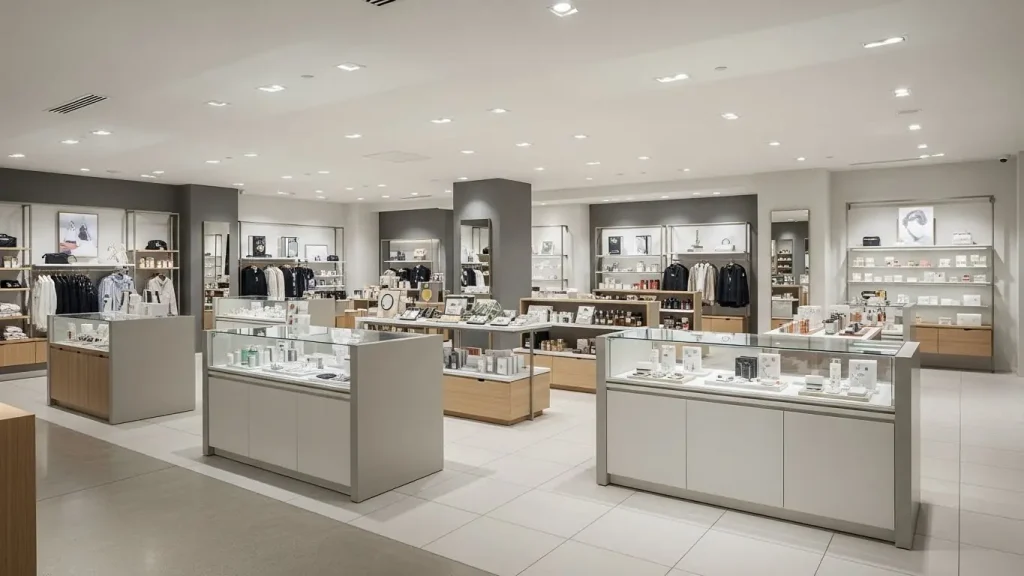
Understanding how retail lighting design influences customer experience allows retailers and designers to create stores that feel inviting, engaging, and easy to shop in—while also translating “experience goals” into practical decisions like track lighting vs LED downlights, زاوية الشعاع, color temperature, CRI (color rendering index), ، و التحكم في الوهج.
If you’re evaluating fixtures for a retail project, these pages help you move from concept to selection faster: LED Track Lighting (accent layer), LED Spot Downlights (ambient base), and the full كتالوج المنتجات.
Why Customer Experience Matters in Retail Stores
Why is customer experience important in retail?Customer experience influences how long shoppers stay, how comfortable they feel, and how likely they are to make a purchase.
Retail customer experience (CX) is not just “nice service.” It’s the full shopping experience: the first impression at the entrance, ease of navigation, comfort while browsing, confidence at the decision moment, and satisfaction after purchase. In physical retail, CX often shows up through:
- Dwell time: how long customers stay in the store and in key zones
- Engagement: whether they stop, look closely, touch products, try items
- Decision confidence: whether the product looks “true” and trustworthy
- Store perception: “premium” vs “cheap,” “modern” vs “dated,” “comfortable” vs “stressful”
Lighting affects all four—and it’s one of the few CX levers that influences every shopper every minute the store is open.
A key insight for decision makers: you don’t “buy lighting.” You design a visual environment. That environment either reduces friction or increases it. It either supports visual merchandising or weakens it.
How Retail Lighting Shapes First Impressions
How does lighting affect first impressions in retail stores?Lighting influences how welcoming, modern, or premium a store feels within the first few seconds of entry.
The first 3–5 seconds of entry are decisive. Shoppers interpret the store instantly: “Is this place worth my time?” Lighting plays a major role in that judgement because it controls perceived:
- Brightness balance (inviting vs harsh)
- Contrast (interesting vs flat)
- درجة حرارة اللون (warm premium vs cold sterile)
- Visual clarity (easy to browse vs confusing)
What “welcoming” lighting actually means
A welcoming retail entrance often has:
- A comfortable ambient lighting base (no dark, underlit entry)
- One or two clear focal points using إضاءة مميزة (feature display, new arrivals, best sellers)
- Glare-free viewing angles (no “lights in the eyes” at the doorway)
A store that feels oppressive usually has:
- Overly bright ceiling + underemphasized products
- Hotspots from poorly aimed track heads
- Uncomfortable glare reflecting off glossy surfaces
- Wrong CCT that clashes with finishes and brand identity
Which fixtures do what?
- أضواء LED سفلية typically create the “calm base” and clean ceiling
- إضاءة المسار creates the “interest points” that pull attention
That’s why most high-performing stores combine both rather than choosing only one category.
Want a fast way to build “first impression focus” without redesigning the ceiling? Start from the adjustable accent layer: LED Track Lighting.
Lighting and Visual Comfort: Why Customers Stay Longer
Visual comfort is a measurable part of customer experience. It’s the difference between “I like browsing here” and “I feel tired and want to leave.”
Key drivers of comfort include:
- Brightness balance (not too bright, not too dim)
- Glare control (no uncomfortable high-luminance sources in view)
- Light direction (avoids harsh shadows on faces or products)
- Uniformity in functional areas (checkout, fitting rooms, aisles)
A crucial truth in retail:
Uncomfortable ≠ customers complain. Uncomfortable = customers silently leave.
Why glare is so damaging
Glare is often created by:
- Narrow-beam track heads aimed into the shopper’s sightline
- Over-bright ceiling fixtures compared to product luminance
- Bad angles on reflective packaging, glass counters, screens
- Poor optics without shielding (no deep reflector or glare-reducing structure)
Designers sometimes reference indoor comfort standards such as EN 12464-1 when discussing glare and comfort, even though retail is not identical to office lighting. In many mixed-use retail zones (checkout, service), targeting a comfort level like UGR < 19 is a practical benchmark for reducing visual stress.
Spec-first guidance (what experienced buyers ask for)
If your goal is comfort that supports longer dwell time, look for:
- Optics designed for التحكم في الوهج
- Stable distribution (no harsh “cone of light” on floors)
- High-quality drivers (flicker-free behavior matters in perception)
- Strong thermal design for stable performance over time
In commercial-grade products, these comfort outcomes often correlate with engineering choices such as:
- Die-cast aluminum heatsink (thermal stability)
- رقائق COB options (smooth beam, controlled intensity)
- عدسة PMMA or controlled reflectors (beam shaping and shielding)
If you’re building a comfort-focused base layer with a clean ceiling, review LED Spot Downlights as the ambient component.
How Lighting Guides Customer Movement and Attention
How does lighting guide customer behavior in retail stores?
Accent lighting directs customer attention to key products and displays, subtly guiding movement and shopping decisions.
Retail is not “random walking.” Shoppers follow cues:
- Where the store feels brightest (but not harsh)
- Where contrast suggests importance
- Where displays look premium and easy to understand
- Where pathways feel safe and comfortable
Lighting is one of the strongest cues because it shapes visual hierarchy. When designed well, it:
- Pulls attention to hero displays
- Creates “pause points” where customers stop and engage
- Encourages movement deeper into the store
- Supports wayfinding without signs
Why track lighting is a behavior tool (not just a fixture)
إضاءة المسار excels at guiding attention because:
- It supports adjustable track lights aimed at focal areas
- It enables fast changes as merchandising changes
- It can create contrast without over-brightening the entire store
Uniform lighting everywhere makes shopping “flat.” Layered lighting with clear accents makes the store feel curated—more like a guided experience.
For merchandising-driven attention control, see LED Track Lighting. If your store changes displays frequently, flexible optics reduce redesign pain—consider أضواء مسار قابلة للتكبير.
Lighting, Color Accuracy, and Customer Trust
Why does color accuracy matter for customer experience?High CRI lighting ensures products look natural and trustworthy, helping customers feel confident about their purchase.
Color accuracy is one of the most direct bridges between lighting and sales. In retail, customers constantly ask themselves:
“Is this the true color? Will it look the same outside? At home?”
When color looks wrong under store lighting, shoppers hesitate. That hesitation reduces conversion and increases returns.
Where CRI matters most
- موضة: accurate fabric colors, prints, and skin tones
- Cosmetics: shade perception and natural appearance
- Food: freshness cues (reds, greens, warm baked tones)
- Jewelry: metal tone clarity and sparkle perception
A practical professional baseline:
- مؤشر CRI ≥ 90 for serious retail
- Premium zones often specify Ra97
- Tight color consistency: SDCM < 3 to avoid “same product, different color” across the store
Color quality is also a brand-control issue. If one store location looks different from another, the brand experience becomes inconsistent.
For projects with high color sensitivity, your selection process should start with product families designed for premium retail presentation. You can shortlist by category using the كتالوج المنتجات.
Creating the Right Retail Atmosphere with Lighting
Retail atmosphere is not abstract—it’s a predictable outcome of CCT, contrast, and comfort.
Color temperature (CCT) as a strategic choice
- Warm CCT often feels cozy, premium, and intimate
- Neutral CCT feels clean, balanced, and broadly flattering
- Cool CCT can feel crisp, modern, and tech-forward
But CCT should be chosen based on brand positioning and category, not personal preference.
Typical guidance:
- 3000 ألف: luxury, boutique, premium storytelling
- 4000 ألف: mainstream retail balance (apparel chains, supermarkets)
- 5000 ألف: electronics, modern “high clarity” environments
Atmosphere = base + accent, not one setting
Atmosphere is usually built from:
- A stable ambient lighting base (downlights or linear)
- Accent lighting highlights (track heads)
- Controlled glare for comfort and trust
This “layered” approach creates both calmness and excitement—key to a strong shopping experience.
Track Lights vs Downlights: Their Impact on Customer Experience
How do track lights and downlights affect customer experience?Downlights create a comfortable base, while track lights add visual interest and product focus, together enhancing the overall shopping experience.
A common mistake in retail is trying to solve everything with one fixture type. Customer experience usually comes from the combination:
- أضواء LED سفلية: comfort, ceiling cleanliness, and consistent navigation visibility
- إضاءة المسار: focal points, excitement, contrast, and visual merchandising control
This division of labor matches how customers shop:
- They need comfort to browse
- They need highlights to notice and desire products
Chart: Fixture roles translated into experience outcomes
| نوع التركيب | Experience Contribution | Best CX Zones | Risk if Used Alone |
|---|---|---|---|
| مصابيح LED سفلية | Calm base, easy navigation, “clean ceiling” | aisles, general area, checkout base | store feels flat, weak product focus |
| إضاءة المسارات | Attention control, product emphasis, excitement | feature wall, mannequins, promotions | patchy base, glare if mis-aimed |
Next step:
- Build your base: LED Spot Downlights
- Build your focus layer: LED Track Lighting
Common Lighting Mistakes That Hurt Customer Experience
Most stores don’t fail because LEDs are “bad.” They fail because the design decisions don’t match real retail behavior.
Common mistakes include:
- Too bright or too dim overall
- Too dim: poor visibility, lower confidence
- Too bright: stress, glare, shorter dwell time
- Strong glare and uncomfortable sightlines
- Customers avoid zones without knowing why
- Checkout becomes stressful if lighting is harsh
- No focal points
- Everything is visible, nothing is emphasized
- Visual merchandising loses power
- Lighting doesn’t match product category
- Wrong CCT (atmosphere mismatch)
- Low CRI (color distrust)
- Wrong beam angle (flat displays or harsh hotspots)
- No clear retail lighting layout
- Random placement, inconsistent experience
- Higher risk of re-aiming chaos after opening
These mistakes are avoidable—if you translate “experience” into a spec-driven plan.
How to Improve Customer Experience with Better Retail Lighting
A practical CX checklist for retail lighting design
Use this checklist to improve customer experience without overcomplicating the project:
- ✅ Use layered lighting (ambient + accent + task)
- ✅ Combine track lighting + LED downlights
- ✅ Choose proper زاوية الشعاع mix (narrow + medium + wide)
- ✅ Specify مؤشر CRI ≥ 90 (premium: Ra97)
- ✅ Maintain SDCM < 3 for consistent store appearance
- ✅ Choose CCT by store type (3000K / 4000K / 5000K)
- ✅ Prioritize التحكم في الوهج (comfort targets like UGR < 19 in sensitive zones)
- ✅ Plan efficiency and operating cost (often 100–130 لومن/واط)
- ✅ Demand commercial lifetime stability (L70/B50 50,000 hrs)
Chart: Customer experience goals → lighting decisions
| CX Goal | What Customers Feel | Lighting Design Move | Fixture Choice |
|---|---|---|---|
| More dwell time | “Comfortable to browse” | balanced ambient + low glare | downlights / linear base |
| More engagement | “This display attracts me” | higher contrast focal accents | track lighting accents |
| More trust | “Color looks true” | CRI ≥ 90, SDCM < 3 | high-CRI track + downlights |
| Better flow | “Easy to navigate” | uniform pathways + highlight zones | ambient base + accents |
| Premium feel | “High-end atmosphere” | controlled contrast + warm/neutral CCT | layered system |
how this works in real retail projects
In real store renovations we support, the highest ROI improvements often come from re-allocating light, not increasing total wattage. A common pattern looks like this:
- Keep a comfortable base using downlights (clean ceiling, easy navigation)
- Add targeted track accents for the 20% of displays that drive 80% of attention
- Upgrade color quality (CRI>90 / Ra97) so products look credible
- Reduce glare and improve angles so customers stay longer near key displays
That is how “customer experience” becomes a measurable lighting plan.
Next step:If you want help translating your store type and merchandising goals into a fixture + spec plan, you can request support via Lighting Solutions & Services or go directly to Contact & Quote.
The four most crucial decision-making comparison tables
Below are four charts that designers and B2B buyers can copy into proposals to justify decisions beyond price.
Chart 1: Retail CX vs Lighting Outcomes
| Lighting Element | What Shoppers Experience | Business Impact |
|---|---|---|
| Poor glare control | discomfort, faster exit | lower dwell time, weaker sales |
| Wrong beam angle | flat displays or harsh hotspots | missed attention and promotions |
| Low CRI | color distrust, hesitation | lower conversion, higher returns |
| No accent layer | nothing stands out | weaker visual merchandising |
Chart 2: Beam Angle as a Merchandising Tool
| نوع الشعاع | زاوية الشعاع | الاستخدام الأمثل | CX Result |
|---|---|---|---|
| Narrow beam | 10°–24° | hero products, mannequins, luxury | strong focus, premium contrast |
| Medium beam | 24°–36° | wall displays, apparel racks | balanced visibility + emphasis |
| Wide beam | 36°–60° | aisles, general shelving | comfortable browsing, uniformity |
Chart 3: CCT Selection by Atmosphere Goal
| CCT | Atmosphere | Best Retail Types |
|---|---|---|
| 3000 ألف | warm, cozy, premium | luxury, boutique, hospitality retail |
| 4000 ألف | clean, balanced | mainstream apparel, supermarkets |
| 5000 ألف | crisp, modern, tech | electronics, modern showrooms |
Chart 4: Spec-First Targets for Consistent CX
| Target Spec | Why It Matters for CX | Practical Benchmark |
|---|---|---|
| Color accuracy | shoppers trust what they see | مؤشر CRI ≥ 90, premium Ra97 |
| Color consistency | store looks uniform and “brand-controlled” | SDCM < 3 |
| راحة بصرية | customers stay longer | glare control, UGR < 19 zones |
| كفاءة | long operating hours, lower cost | 100–130 لومن/واط |
| Lifetime planning | fewer failures and complaints | L70/B50 50,000 hrs |
FAQ About Retail Lighting Customer Experience
Does lighting affect customer behavior in retail?
Yes. Lighting influences attention, comfort, and perceived product quality. Accent lighting can guide shoppers to key displays, while poor glare control reduces dwell time.
Can better lighting increase retail sales?
Better lighting can support higher conversion by improving product presentation, customer comfort, and trust—especially through proper beam angles, high CRI, and layered lighting.
What lighting is best for customer experience?
A layered approach works best: ambient lighting for comfort (often downlights), accent lighting for focus (track lighting), and task lighting for checkout and staff areas.
How bright should retail lighting be?
Brightness should be balanced: enough for easy browsing without causing glare or fatigue. Many stores perform better with contrast and focal lighting rather than “maximum brightness everywhere.”
What role does LED lighting play in retail experience?
LED enables efficient, controllable lighting with stable CCT and high CRI options. The experience outcome depends on design—beam angles, glare control, and fixture selection—more than LED itself.
Welcome to discuss business cooperation
Retail lighting influences customer experience because it controls what shoppers notice, how comfortable they feel, and whether they trust what they see. When you translate CX into lighting design and selection, the path becomes clear:
- Build comfort with ambient lighting (often أضواء LED سفلية)
- Create excitement and focus with إضاءة مميزة (إضاءة المسار)
- Protect trust with CRI > 90 / Ra97 و SDCM < 3
- Keep customers longer with التحكم في الوهج (comfort targets like UGR < 19 in sensitive zones)
- Reduce operating cost with 100–130 لومن/واط كفاءة
- Reduce complaints and rework with L70/B50 50,000 hrs lifetime planning
Direct next steps:
- Accent layer for visual merchandising: LED Track Lighting
- Ambient comfort base: LED Spot Downlights
- Flexible optics for changing displays: أضواء مسار قابلة للتكبير
- Full product overview: كتالوج المنتجات
- Strategic support & project guidance: Lighting Solutions & Services
- Get a recommendation fast: Contact & Quote