 XHLUX
XHLUX

جدول المحتويات
- 1. Why Supermarket Lighting Is Shifting from Fixture Choice to System Choice
- 2. What Is a Supermarket Continuous LED Linear Lighting System?
- 3. Why Traditional “Point-Source” Fixtures Are Becoming Less Cost-Effective in Supermarkets
- 4. Core Value of Continuous LED Linear Lighting in Supermarkets
- 5. How Continuous Linear Lighting Works Across Supermarket Zones
- 6. Continuous Linear Systems vs Dispersed Fixtures
- 7. What a Mature Supermarket Continuous Linear Lighting System Includes
- 8. Key Considerations When Choosing a Supermarket Linear Lighting System
- 9. Why Continuous Linear Lighting Supports Chain Replication and Standardization
- 10. Common Mistakes When Using Continuous Linear Lighting in Supermarkets
- 11. FAQ About Supermarket Linear Lighting System
- 12. Why Continuous LED Linear Lighting Systems Are a Rational Choice for Modern Supermarkets
- Business collaborations are welcome
1. Why Supermarket Lighting Is Shifting from Fixture Choice to System Choice
Supermarkets are not “normal” commercial spaces. They are a combination of large floor area, high operating hours, ، و high energy sensitivity—often running lighting 12–16 hours per day, sometimes longer for replenishment, cleaning, and late-night operations.
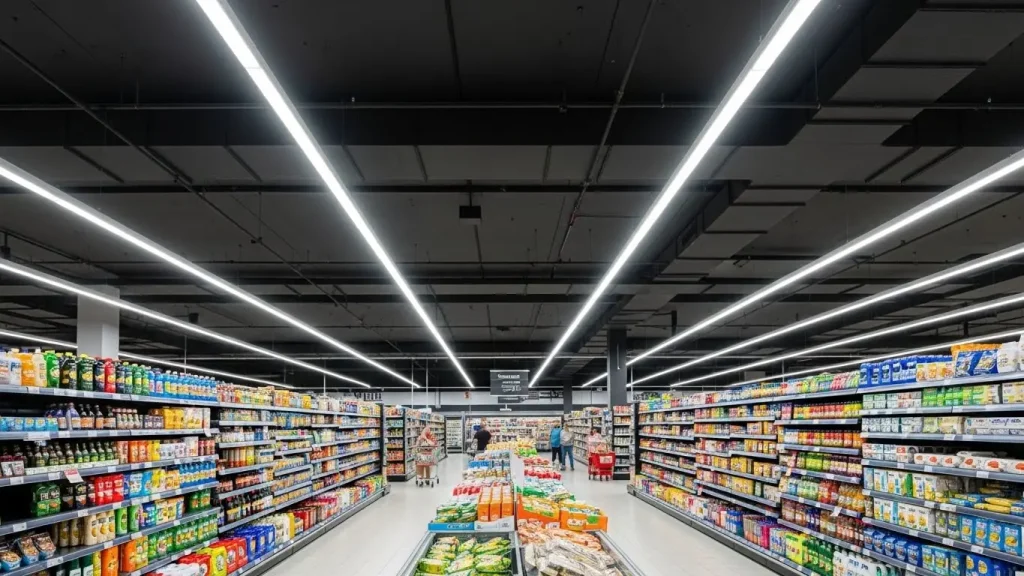
In this environment, lighting is no longer just a design decision. It affects:
- Energy and operating cost over 5–10 years
- Shopper comfort and perceived cleanliness
- Merchandise visibility, especially on shelves
- Maintenance workload and fault risk across hundreds (or thousands) of luminaires
This is why more project teams search for supermarket linear lighting system instead of “downlight” or “panel” alone. They are really asking:
How do we build a lighting approach that remains efficient, controllable, and easy to maintain as the store operates for years—without constant retrofits?
That question naturally leads to continuous LED linear lighting systems—not as a style preference, but as a system solution.
2. What Is a Supermarket Continuous LED Linear Lighting System?
A continuous LED linear lighting system is not simply “multiple linear lights installed next to each other.” It is a coordinated system where structure, optics, and electrical design work together to deliver a continuous result.
What “Continuous” Means in a Supermarket Context
A true supermarket system typically includes:
- Multiple linear modules built for continuous run
- Joint designs that maintain appearance continuity
- Optical continuity that minimizes dark gaps or bright hot spots
- Electrical continuity that supports long runs و stable output
In supermarkets, this is not decorative lighting. It becomes the core lighting backbone, providing:
- Base illumination for main aisles and circulation
- A structured light layout that can align with racks, gondolas, and signage
- A scalable platform for dimming and zoning control
One-sentence definition:A supermarket continuous LED linear lighting system is an integrated long-run linear solution designed for large-area, high-density retail environments with consistent light quality and operational efficiency.
If your store lighting strategy includes architectural linear lighting, this is the category most projects will map to:LED Linear Lighting Series.
3. Why Traditional “Point-Source” Fixtures Are Becoming Less Cost-Effective in Supermarkets
This is the root problem section—where many supermarket upgrades start.
Common Issues with Downlights / Panels as the Primary Strategy
Point-source strategies (downlights, panels, small fixtures) often create predictable outcomes in supermarkets:
- Too many fixtures → more failure points
- Bright floor, darker shelves → wasted light where it doesn’t sell
- Visual clutter → ceiling appears busy and inconsistent
- Higher maintenance load → more SKUs, more replacements, more labor
When shelves look dark, a common reaction is “add more fixtures” or “increase wattage.” That works in the short term, but it usually produces:
- Higher energy consumption
- Higher glare potential
- More ongoing maintenance
- A less controlled overall result
In supermarket operations, a simple truth shows up quickly:
“More fixtures” often means “lower system efficiency.”
Data Table: Why “Many Small Fixtures” Increases Operational Risk
| System Characteristic | Dispersed Fixtures (Downlights / Panels) | Continuous Linear Systems |
|---|---|---|
| Number of luminaires | عالي | Lower for same coverage |
| Failure points | كثير | Fewer |
| Visual uniformity | Installer-dependent | System-controlled |
| Shelf visibility potential | Often lower unless over-powered | Higher with better distribution |
| Maintenance complexity | عالي | Lower / more standardized |
This shift is not about fashion. It’s about long-term cost and controllability.
4. Core Value of Continuous LED Linear Lighting in Supermarkets
This is the most persuasive section because it connects lighting to operations.
4.1 Uniform, Continuous Illumination
Continuous linear runs naturally reduce “patchiness” and avoid the “islands of light” feeling created by point-source layouts.
4.2 Cleaner Visual Ceiling, Stronger Store Order
A continuous line of light can reinforce store axes, create a cleaner ceiling, and improve the perception of retail hygiene—especially important in supermarkets.
4.3 Better Alignment with Shelf Layouts
Supermarkets sell on shelves, not on floors. Linear systems can be designed to align with gondolas and aisles—supporting vertical visibility more effectively than scattered downlights.
4.4 Fewer Fixtures, Fewer Faults
A system approach reduces the number of individual luminaires and parts. That reduces fault probability and simplifies maintenance planning.
4.5 A Platform for Control (DALI / 0–10V)
Continuous linear systems pair well with zoning and dimming strategies. Dimming is not only for mood—it’s an operational tool for energy and schedule optimization.
One-sentence summary:Continuous linear lighting exists for long-term operational stability—not just for aesthetics.
If you build projects with standardized systems, this is where a supplier’s solution capability matters most:
Commercial Lighting Solutions
5. How Continuous Linear Lighting Works Across Supermarket Zones
A supermarket is a multi-zone environment. The biggest mistake is applying a single lighting logic everywhere.
5.1 Main Aisles & Secondary Circulation
- Prioritize continuous uniformity
- Maintain comfortable navigation brightness
- Reduce glare on polished floors
Linear systems excel here because they create consistent wayfinding light.
5.2 Shelf Aisles (Gondola Aisles)
The selling happens on shelves. Shelf aisles benefit from:
- Light distribution that supports vertical surfaces
- Options such as asymmetric optics (especially in high-rack formats)
- Continuous lines that avoid dark “holes” along product runs
If your aisle strategy uses directional optics, a continuous linear platform becomes the ideal backbone.
5.3 Fresh Food Areas
Fresh food zones often require higher attention to color and presentation:
- Fresh meat, produce, bakery each has different visual needs
- Over-lighting causes glare and “washed out” product appearance
- Dimming and zoning matter to prevent harshness
Here, continuous linear systems can act as the base layer, while specialty luminaires provide category enhancement.
5.4 Checkout Zones
Checkout zones require:
- Stable brightness for transaction comfort
- Reduced visual fatigue under long dwell times
- Consistent exposure for security cameras (where applicable)
Continuous systems help avoid random brightness changes caused by point-source layouts.
5.5 Back-of-House / Storage
Back-of-house requires:
- efficiency and reliability
- easy maintenance
- standardized spare parts
Continuous systems reduce SKU complexity and improve uptime.
6. Continuous Linear Systems vs Dispersed Fixtures
Supermarket decisions should be made as operational decisions, not fixture decisions.
Operational Comparison Table
| عامل القرار | Dispersed Fixtures | Continuous Linear System |
|---|---|---|
| Initial planning requirement | أدنى | Higher (layout + runs) |
| Visual outcome control | أدنى | أعلى |
| Maintenance burden | أعلى | أدنى |
| Expansion / replication | Harder | أسهل |
| Long-term operational efficiency | Often lower | Often higher |
For chain supermarkets, the key factor is not “flexibility to change randomly.” It is:Stability and replicability across stores.That’s why system choice increasingly beats single-fixture choice.
7. What a Mature Supermarket Continuous Linear Lighting System Includes
Not all “continuous” products are true systems. A mature system usually includes these design elements:
7.1 Seamless Joint Engineering
- No visible dark gaps
- No bright hot spots at connections
- Mechanical alignment that resists installation tolerance issues
7.2 Optical Consistency
- Uniform diffusion and cut-off behavior across the entire run
- Stable beam pattern so shelves don’t alternate bright/dim every module
7.3 Electrical Continuity for Long Runs
- Designed power routing
- Practical segmentation for maintenance
- Stable output across distance
7.4 Modular Planning and Standardization
- Standard modules for easier replication
- Corner / T / cross options when needed
- Predictable layout planning for ceiling grids
7.5 Control Compatibility
Dimming and zoning support such as:
- DALI / DALI-2
- 0-10 فولت
For reference on DALI as a protocol concept, see:Digital Addressable Lighting Interface (DALI) on Wikipedia and the official industry body:DALI Alliance.
Key reminder:A true continuous system solves joints and continuity in design—not by installer “skills.”
8. Key Considerations When Choosing a Supermarket Linear Lighting System
This is the practical checklist section that helps projects avoid regret.
8.1 Is It Truly Designed for Continuous Run?
Ask whether the product family includes:
- joint components designed for “no dark zone”
- continuous wiring strategy
- tested long-run behavior
8.2 Joint Performance: Dark Zone vs Hot Spot
A high-quality system should minimize both.
Data Table: Quick Joint Quality Inspection Checklist
| Check Item | What You Want to See | Red Flag |
|---|---|---|
| Joint brightness | visually consistent | visible dark gap / bright dot |
| Mechanical alignment | straight line | “broken line” effect |
| Diffuser continuity | continuous appearance | obvious seam outline |
| Color consistency | no shift across modules | warmer/cooler segments |
8.3 Optics Fit the Aisle & Shelf Geometry
If shelves are tall, symmetric “down-only” distribution may waste light on floor. Consider optics that prioritize merchandise visibility.
8.4 Dimming & Zoning Support
Supermarkets benefit from time-based dimming strategies (late night, off-peak, cleaning). Dimming support matters more than many teams assume.
8.5 Long Operating Hours Reliability
Supermarket systems must survive high daily runtime. This is where thermal management and system design matter more than marketing claims.
8.6 Maintenance Strategy
Ask these questions early:
- Can modules be replaced without destroying the whole run?
- Are drivers accessible?
- Are spare parts standardized?
8.7 Proof of Large-Scale Experience
A supplier should show large-area retail deployment logic, not only small office samples.
Practical warning:
Supermarket lighting is where “cheap now” becomes “expensive later.”
9. Why Continuous Linear Lighting Supports Chain Replication and Standardization
For supermarket chains, lighting is part of operational standardization.
Chain-Level Benefits
- A unified store lighting identity
- Reduced design variance between regions
- Faster new-store rollout with predictable results
- Easier headquarters-level control strategy alignment
- Lower overall maintenance complexity
In real chain operations:
Continuous linear lighting becomes an “invisible standardization tool.”
If you want a project-ready package (layout logic + product matching + control options), this is typically handled at solution level:Project-based Lighting Solution Support
10. Common Mistakes When Using Continuous Linear Lighting in Supermarkets
Even good systems can fail if the project logic is wrong.
Mistake 1: Forcing Ordinary Linear Lights into Long Runs
“Hard拼接” is the fastest way to create visible seams and inconsistent brightness.
Mistake 2: Only Designing for Floor Lux
Retail success depends on merchandise visibility. Shelf faces matter.
Mistake 3: Ignoring Long-Run Power Planning
Long-distance runs require stable electrical planning. Weak power planning often shows up as brightness differences.
Mistake 4: Approving Samples Without Full-Run Mockups
A 1-meter sample can look perfect. A 20-meter run reveals joint and consistency problems immediately.
Mistake 5: Skipping Control Strategy
Without zoning and dimming logic, supermarkets often waste energy and create visual discomfort at night.
Reminder:
Continuous linear lighting failures are usually system failures—not LED failures.
11. FAQ About Supermarket Linear Lighting System
Q1: Are continuous linear lighting systems only for large supermarkets?
They are most effective in medium-to-large stores, but smaller formats also use them to improve uniformity and reduce ceiling clutter.
Q2: Are they more energy-efficient than downlights?
Often yes—because light distribution can be more usable and fewer fixtures may be required for the same outcome.
Q3: Can continuous linear systems work with DALI dimming?
Yes. DALI is a common pairing for zoning and time-based control.
Q4: Is maintenance more difficult?
Proper system design can simplify maintenance through standard modules and planned access points.
Q5: Are they suitable for supermarket retrofits?
Yes—especially for energy upgrades and long-term operational improvement projects.
12. Why Continuous LED Linear Lighting Systems Are a Rational Choice for Modern Supermarkets
Supermarket lighting is a long-term, high-load system.
Dispersed fixture strategies often become expensive through:
- excessive fixture counts
- uneven results
- maintenance complexity
- difficulty standardizing across stores
Continuous LED linear lighting systems provide:
- cleaner, more consistent store lighting
- better alignment with retail layout logic
- fewer failure points
- stronger control potential (DALI / 0–10V)
- lower long-term operational burden
For supermarket operators and chain decision-makers, this is not “switching fixtures.”
It is a lighting system upgrade designed for sustainable retail operations.
Final takeaway:Continuous LED linear lighting systems are the backbone solution for efficient, scalable supermarket lighting.
Business collaborations are welcome
If you are planning a new store or upgrading an existing supermarket, the fastest way to reduce risk is to align early on:
- store layout and aisle geometry
- continuous run lengths and joint strategy
- optics approach (shelf-focused vs general)
- control strategy (DALI / 0–10V, zoning, schedules)
- maintenance plan and standardization goals
If you want us to match the right continuous linear system to your supermarket layout and operating model, you can:👉 request a project-based lighting solution plan or go directly to:👉 contact us to share your floor plan and requirements
For product-side reference when building your fixture schedule, you can also review our:
- LED Linear Lighting Series (continuous run / aisle systems)
- LED Spot Downlights (feature zones and accents)
- LED Pendant Lighting (checkout / public zones)