 XHLUX
XHLUX

جدول المحتويات
- First Question: What Makes a Fixture “Commercial Grade”
- A Breakdown of Commercial Track Lighting Fixture Types
- How To Understand Key Indicators And Specifications
- Market Insights & The Future of the Fixture
- Final Word: Your Fixtures Are Your Most Important Tools
- FAQ About Commercial Track Lighting Fixtures
A track lighting system is a platform of pure possibility. But the platform itself, the sleek metal track on your ceiling, is only half the story. The real magic—the part that shapes the customer experience, makes your products irresistible, and brings your brand to life—lies in the commercial track lighting fixtures you choose to populate it with.
Selecting the right fixtures is like a master chef choosing the perfect knife for a specific cut. It requires a deep understanding of the tool, the task at hand, and the desired outcome. The market is flooded with options, but the fixtures designed for the rigors and ambitions of a commercial environment are in a class of their own.
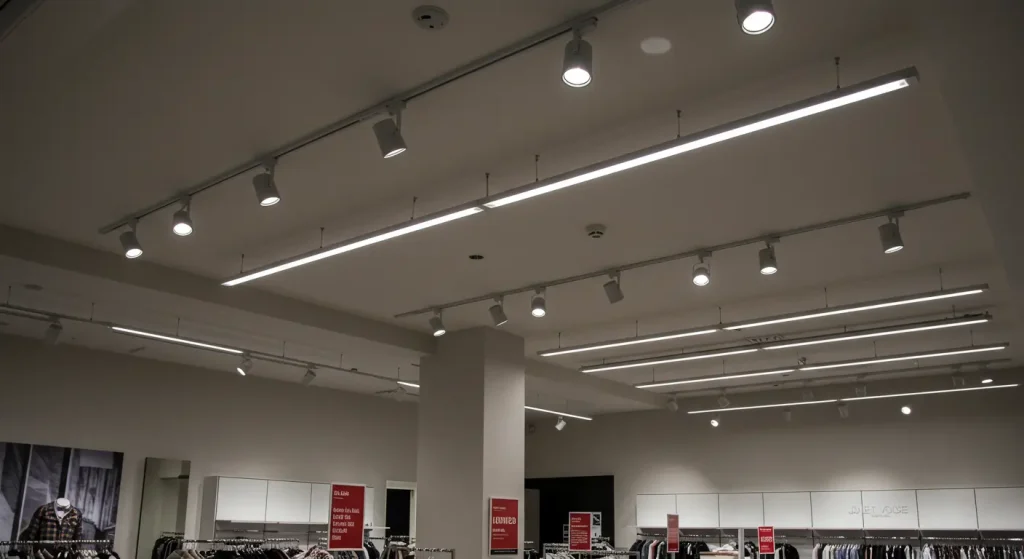
So, what separates a professional-grade fixture from a residential one? What are the essential types of fixtures you need in your toolkit? And how do you decode a technical specification sheet to make a truly informed choice?
First Question: What Makes a Fixture “Commercial Grade”
Before we look at different types, let’s establish the baseline for quality. A fixture earns the “commercial grade” designation through superior engineering and performance across four key areas. When you specify a fixture, you are investing in these attributes.
1. Robust Construction & Superior Thermal Management
A commercial fixture runs for thousands of hours a year, often at high output.
- Built to Last: Look for fixtures with solid, die-cast aluminum housings, not flimsy stamped metal or plastic. This ensures durability and provides the mass needed for heat dissipation.
- Engineered Heat Sinks: Heat is the primary enemy of an LED’s lifespan and color stability. A commercial fixture has a meticulously engineered heat sink designed to pull heat away from the sensitive LED chip, ensuring it meets its 50,000+ hour life rating without performance degradation.
2. Precision Optics for High-Performance Control
In a commercial space, you can’t afford to have light spilling into unwanted areas or causing discomfort.
- Advanced Lenses & Reflectors: Professional fixtures use high-quality TIR (Total Internal Reflection) lenses or precisely engineered reflectors to shape the light into a clean, controlled beam with minimal light spill.
- Superior Glare Control: This is a non-negotiable. Look for fixtures with deeply recessed LED sources, matte black baffles, and the option to add accessories like honeycomb louvers. For office environments, this means specifying fixtures capable of achieving a UGR (Unified Glare Rating) of less than 19.
3. The Professional-Grade LED Driver
The driver is the electronic heart of the fixture. A cheap driver is the most common point of failure.
- Reliability: Commercial drivers are built with higher quality components to withstand long operating hours and electrical fluctuations.
- Performance: They provide clean, stable power for flicker-free operation and offer smooth, deep dimming capabilities (often down to 1% or lower) that are compatible with professional control systems.
4. Uncompromising Light Quality
The quality of the light itself is a direct reflection of your brand.
- High CRI & R9: A مؤشر تجسيد اللون (CRI) of 90+ is the professional baseline. For retail, galleries, and hospitality, specifying CRI 95+ with a high R9 (red rendering) value is essential for ensuring products and people look their absolute best.
- Color Consistency: Commercial-grade fixtures guarantee tight color consistency (within a 2-3 step MacAdam ellipse), ensuring that every fixture in your installation produces the exact same color of white light.
A Breakdown of Commercial Track Lighting Fixture Types
With the quality baseline established, let’s explore the primary tools in your design toolkit.
| نوع التركيب | Primary Function | Typical Beam Angle | التطبيق المثالي |
|---|---|---|---|
| Spotlight (Accent) | To Create Focus: Highlights specific products, objects, or architectural details. Creates drama and visual hierarchy. | Narrow (< 25°) | Highlighting hero products in retail, accenting artwork in a gallery, creating focal points in a lobby. |
| Floodlight (Ambient) | To Provide General Light: Creates the base layer of comfortable, even illumination for navigating a space. | Wide (> 40°) | Providing overall ambient light in a showroom, office, or circulation space. |
| Wall Washer | To Illuminate Vertical Surfaces: Creates a smooth, even wash of light on a wall, making a space feel larger and brighter. | Asymmetric | Lighting large branded walls, backdrops in retail, gallery walls, and corridors. |
| قلادة | To Provide Task & Decorative Light: Brings light down to a human scale over tables, counters, and reception desks. Adds a decorative element. | Varies by shade | Task lighting over a restaurant table or a retail cash wrap; adding a stylistic feature. |
| Zoomable / Framing | The Ultimate Flexible Tool: A single fixture that can be adjusted to perform multiple roles, from a tight spot to a wide flood. | Variable (e.g., 10°-60°) | Dynamic environments like galleries and museums; high-end retail with frequently changing displays. |
The Spotlight: The Hero of Your Display
This is your primary tool for creating focus. A commercial-grade spotlight will offer a narrow, crisp beam with high intensity (measured in CBCP – Center Beam Candle Power) to make your key items pop.
The Floodlight: The Foundation of Your Space
These fixtures provide the comfortable ambient light that makes a space feel welcoming. They have a wider beam and softer edges that overlap to create a seamless, even layer of illumination.
The Wall Washer: The Creator of Space and Drama
A true wall washer is a specialized fixture with an asymmetric optic that directs light sideways and downwards to evenly illuminate a vertical surface. This technique is one of the most effective ways to make a space feel more spacious, luxurious, and visually impressive.
The Power of a Cohesive Ecosystem
Choosing the right fixtures is made infinitely easier when you select a brand that offers a complete and cohesive ecosystem. This means you can find spotlights, floodlights, and wall washers that share the same design language, finish, and, crucially, the same high-quality LED chip for perfectly consistent light quality across your entire project. Leading manufacturers and specialized suppliers, such as those showcasing their collections on platforms like xhlux, often present these “families” of fixtures, simplifying the specification process and guaranteeing a unified, professional result.
How To Understand Key Indicators And Specifications
When comparing commercial track lighting fixtures, you’ll be looking at a technical specification sheet. Here’s what the key numbers mean for your business.
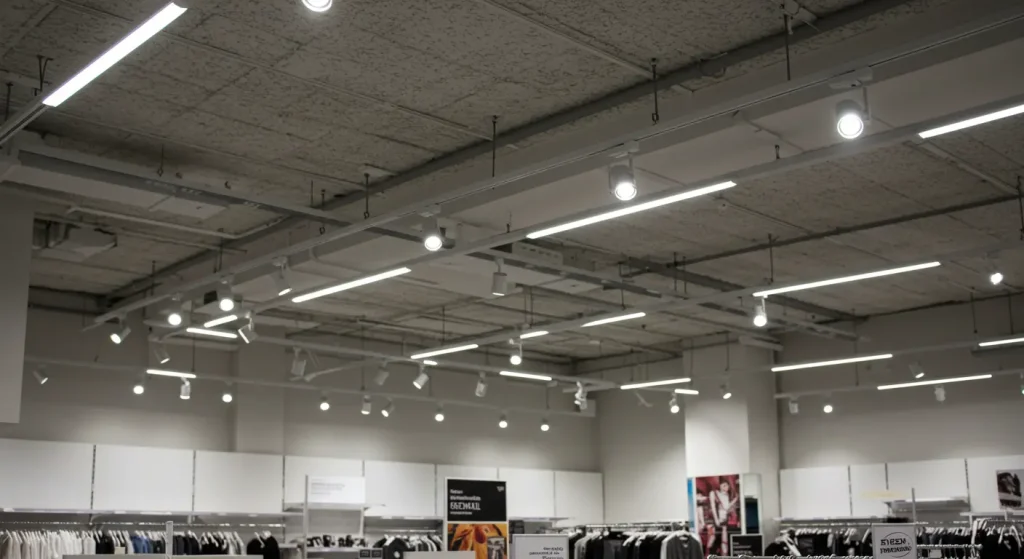
- Delivered Lumens & Efficacy (lm/W): Lumens tell you the fixture’s total brightness. Efficacy (lumens per watt) tells you how efficiently it produces that light. A higher efficacy means lower energy bills.
- CRI / R9 / TM-30: These are your color quality metrics. Demand CRI 90+ and ask for the R9 value. TM-30 is a newer, more comprehensive metric that signals a manufacturer is at the forefront of light quality science.
- Beam Angle & CBCP: Beam angle tells you the spread of the light. CBCP (Center Beam Candle Power) tells you the intensity at the center of the beam—a high CBCP means more “punch” for accent lighting.
- UGR (Unified Glare Rating): A critical metric for any space where people will be working or dwelling. For offices, UGR<19 is the professional standard to ensure visual comfort.
- Driver & Dimming Protocol: The spec sheet will list the type of driver and its dimming compatibility (e.g., TRIAC/Phase, 0-10V, DALI, ELV). This must match your chosen control system.
Market Insights & The Future of the Fixture
The global market for commercial lighting is experiencing a profound technological shift. As outlined in a recent analysis by MarketsandMarkets, the demand for connected (IoT) lighting in commercial spaces is projected to grow significantly through 2025 and beyond.
This trend is reflected in the evolution of the fixture itself:
- On-board Intelligence: Fixtures are increasingly available with integrated sensors for occupancy and daylight harvesting, or with built-in wireless control nodes (like Casambi). The fixture is becoming a smart device.
- Human-Centric Design: The focus is shifting from pure efficiency to the light’s effect on people. This is driving the adoption of tunable white fixtures that can change color temperature to support well-being and productivity.
- Sustainability & Modularity: There is a growing demand for fixtures that are not only energy-efficient but also designed for a circular economy, with replaceable drivers and LED modules to extend their lifespan and reduce waste.
Final Word: Your Fixtures Are Your Most Important Tools
In a commercial environment, your lighting fixtures are not passive objects. They are active tools that work for you every minute your business is open. They attract customers, highlight value, create comfort, and communicate your brand’s commitment to quality.
Choosing a generic, low-grade fixture is like asking a master chef to work with a dull knife. It undermines their skill and leads to a subpar result. By investing in professional-grade commercial track lighting fixtures—defined by their robust construction, precision optics, and superior light quality—you are empowering your space to perform at its absolute best.
Ready to select the perfect toolkit of fixtures for your commercial project?
The options are vast, and the technical details matter. Our team of commercial lighting specialists can help you navigate the specifications and select the ideal combination of spotlights, floodlights, and wall washers to achieve your specific business goals.
Contact us today for a professional consultation and let’s build your high-performance lighting system.