XHLUX
XHLUX

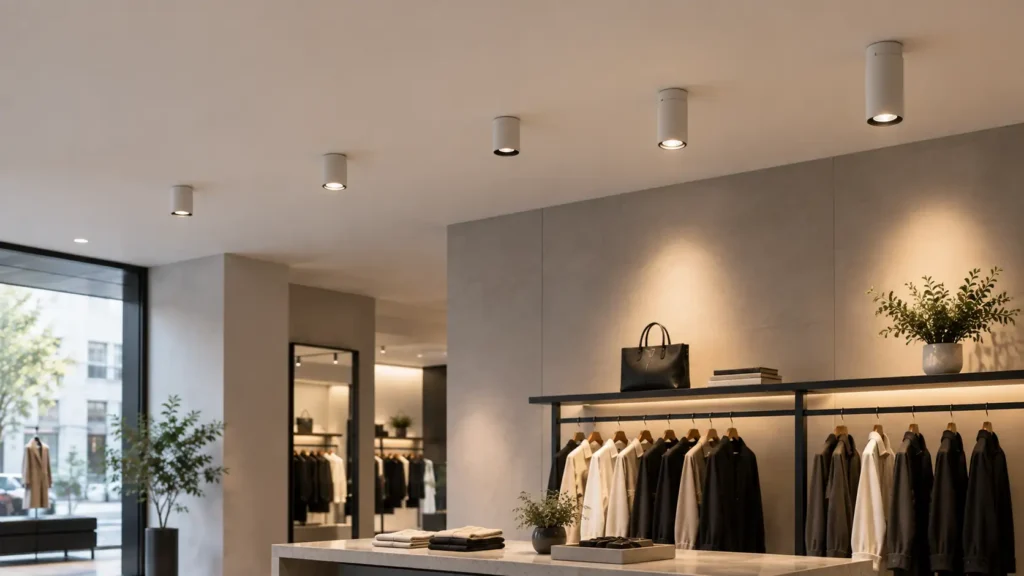
Two surface ceiling spotlights can have a similar diameter and appearance from below, yet one housing may be much taller than the other.
Housing height is not only an appearance size. It can relate to where the driver sits, how much thermal structure the body needs, how deep the optic or reflector package runs, whether an adjustable or tilting mechanism is inside, how far the fixture projects below the ceiling, and how many components must fit in one package.
A taller body is not automatically better or more powerful. Height is a packaging outcome—not a performance score.
A surface ceiling spotlight mounts on the finished ceiling plane rather than sitting inside a recessed cut-out. It may be selected because recessing is impractical—or simply because the surface mount ceiling spotlight / no-recess ceiling spotlight form suits the project.
For no-recess ceiling language on commercial interiors, start from مصابيح LED مثبتة على السطح للأسقف غير المجوفة.
باختصار شديد: Housing height describes how the driver, thermal path, optic and sometimes aiming mechanism are packed into a surface body. Compare drawings and optical data—not height alone—when you weigh short versus tall.
جدول المحتويات
- 📏 1. What does “housing height” mean on a surface ceiling spotlight?
- 🔧 2. Why are some surface ceiling spotlights taller than others?
- ⬇️ 3. What does a shorter housing actually change?
- ⬆️ 4. What does a taller housing actually change?
- 🔦 5. Does housing height change the beam angle?
- 👀 6. Does housing height affect glare?
- 🏢 7. Why housing height matters more on a low ceiling
- 📐 8. How much installation clearance does a surface spotlight need?
- ✅ 9. How should you compare surface spotlight housing options?
- 🧭 10. Short or tall: which housing should you choose?
- ⚠️ 11. Common mistakes
📏 1. What Does “Housing Height” Mean on a Surface Ceiling Spotlight?
Housing height is the overall depth of the luminaire body once it is fixed to the mounting surface—how far the main package extends downward from that plane.
Keep it separate from diameter, from the mounting base footprint, and from the movement envelope of an adjustable head.
Housing height describes the physical package of the luminaire. It does not by itself tell you beam angle, wattage or lighting quality.
🎯 What is housing height here?
It is how far the surface body projects below the mounting plane—not a beam, wattage or quality score by itself.
🔧 2. Why Are Some Surface Ceiling Spotlights Taller Than Others?
Height is usually the result of several internal decisions working together—not one single “style” choice.
Driver position
Some designs put the driver inside the housing, in the mounting base, or remote from the body.
When more electrical components must sit in the visible package, internal volume can grow. An integrated driver can affect housing height; it does not always force a taller body.
التصميم الحراري
LED sources and drivers need a workable thermal path. Wattage class, heat-sink geometry, materials and airflow all change how much body depth the design uses.
A taller body may provide more internal thermal volume. Height alone is not proof of better heat dissipation.
Optical depth
Deeper reflectors, lens positions, recessed sources or shielding structures can lengthen the optical package—and with it the housing.
Adjustable mechanism
Tilt, pivot, rotation or internal articulation needs mechanical room. A fixed head and an adjustable head that look similar from below can still differ in housing height.
In project reviews, we often see two catalogue photos that look alike until the side drawing shows a very different body depth.
🎯 Why do housing heights differ?
Because driver layout, thermal volume, optic depth and aiming mechanisms share one package—not because taller means stronger.
⬇️ 3. What Does a Shorter Housing Actually Change?
A shorter housing usually means less visual projection below the ceiling. On low ceilings, clean architectural planes and compact interiors, that can keep the ceiling reading lighter.
It also often means less internal packaging space for the driver, heat sink, optic and movement mechanism.
Shorter does not automatically mean lower wattage, poorer thermal performance or a wider beam. Those claims still need the real design and datasheet.
🎯 What does a short housing change?
It mainly reduces projection and packaging volume—not wattage, thermal class or beam by default.
⬆️ 4. What Does a Taller Housing Actually Change?
A taller housing can open more room for components, a deeper optical package, more thermal structure or certain aiming mechanisms.
The trade-off is more visibility below the ceiling, greater visual mass, tighter proportion questions on low ceilings, and sometimes a larger movement envelope when the head tilts.
A taller housing can solve packaging problems inside the fixture, but it also becomes a stronger architectural object below the ceiling.
🎯 What does a tall housing change?
It can ease internal packaging—and it makes the fixture a stronger object under the ceiling.
🔦 5. Does Housing Height Change the Beam Angle?
Not directly.
Surface mount ceiling spotlight beam angle is set mainly by the optic, reflector or lens, the source-to-optic relationship and the overall optical design.
Housing height may indirectly allow a deeper reflector, a more recessed source position or a different shielding geometry. That is still not the same as “taller equals narrower.”
Two fixtures with the same housing height can carry different beam angles. Two fixtures with the same beam angle can still use different housing heights.
For beam choice as a follow-on check, see ما هي زاوية الشعاع الأنسب لإضاءة المسارات التجارية؟.
🎯 Does height set the beam?
No. Beam comes from the optic design; height only sometimes enables a deeper optical package.
👀 6. Does Housing Height Affect Glare?
A deeper body can help the source sit farther from the aperture and gain more shielding or cutoff. Source visibility from typical viewing angles may then change.
Glare still depends on source position, reflector or lens, aperture, shielding, viewing angle, aiming and the application itself.
Housing depth can contribute to glare control, but housing height alone is not an anti-glare rating.
🎯 Is taller anti-glare by default?
No. Depth can help shielding, but glare still needs optic, aiming and viewing geometry—not height alone.
🏢 7. Why Housing Height Matters More on a Low Ceiling
On a low ceiling, the same extra millimetres of projection often feel stronger. The fixture sits closer to eye level, the body reads as a clearer object, repeated heads amplify the pattern, and tilted heads can look even more prominent.
Selection then needs total fixture height, diameter, mounting density, finish colour and the adjustable-head envelope together—not a fixed “must use short housings below X metres” rule.
🎯 Why care more on low ceilings?
Because the same projection sits closer to eye level and repeats more strongly across the plane.
📐 8. How Much Installation Clearance Does a Surface Spotlight Need?
Surface-mounted does not mean zero clearance. A no-recess ceiling spotlight usually skips a large ceiling void, but ceiling spotlight installation clearance still matters around the finished plane.
Check the mounting base, wiring entry, junction or connection space, driver position, tilt or rotation movement, nearby ducts or trays, and access for install and service.
If the head is adjustable, also check whether the movement envelope clears the ceiling, wall or neighbouring fixtures.
For recessed paths that do need a void, the contrast is clear in أضواء كاشفة LED غائرة للمشاريع التجارية—surface work still needs its own envelope on the room side of the ceiling.
Check the full installation envelope, not only the body height printed on the product page.
🎯 Is surface mount clearance-free?
No. Skip the large void if the design allows—but still check base, wiring, driver and movement envelope.
✅ 9. How Should You Compare Surface Spotlight Housing Options?
When you compare surface spotlight housing options, keep the list around height and packaging—not a full product shortlist.
| يفحص | لماذا يُعد ذلك مهماً؟ |
|---|---|
| Total housing height | How far the fixture projects below the ceiling |
| Body diameter | Overall visual proportion |
| موقع السائق | Affects internal packaging and service |
| Optic depth | May affect source position and shielding |
| Fixed or adjustable head | Changes required mechanism space |
| Tilt / rotation envelope | Determines movement clearance |
| Mounting base size | Affects ceiling interface |
| Wiring entry / connection space | Affects installation practicality |
Compare drawings, not just catalogue photos.
🎯 How do you compare housings fairly?
Side-by-side drawings for height, base, driver, optic depth and movement—not photos alone.
🧭 10. Short or Tall: Which Housing Should You Choose?
Start with ceiling proportion
Is the projection under the finished ceiling acceptable?
Check internal architecture
How are driver, thermal path, optic and adjustment arranged?
Check the lighting task
Do beam, aiming and glare control meet the brief—independent of body height?
Check installation envelope
Do base, wiring, movement and service access fit the ceiling?
Choose the housing height that fits the optical, mechanical and installation requirements—not simply the shortest body available.
🎯 How do you choose short vs tall?
Match proportion, packaging, lighting task and install envelope—not “shortest wins.”
⚠️ 11. Common Mistakes
- Assuming a shorter housing is automatically more advanced
- Assuming a taller housing means higher wattage
- Choosing by body height without checking the optic
- Ignoring driver location and service access
- Looking only at static dimensions and forgetting tilt / rotation clearance
ما الخطوة التالية؟
- Note ceiling height and how much projection you can accept under the finished plane.
- Ask for side drawings that show housing height, base, driver location, optic depth and any tilt envelope.
- Separate packaging questions from beam, aiming and glare data on the sheet.
- Need a project review or quotation? Contact the XHLUX team with application, ceiling type, preferred projection, fixed or adjustable need, beam requirement and service-access constraints.
🏁 Conclusion: Why do surface ceiling spotlight housings differ in height?
Surface ceiling spotlights come in different housing heights because the body has to package the driver, thermal system, optics and sometimes an aiming mechanism.
Housing height affects physical packaging, installation and visual proportion—but it does not by itself determine wattage, beam angle or lighting quality.
Compare the complete fixture drawing and optical data, not housing height alone.
Explore our related blog posts:
- Surface-Mount Cylinder Downlights: When Should You Use Them?
- What Are Surface-Mounted COB Lights and When Should You Use Them?
- كيفية اختيار مصباح السقف المدمج المناسب للديكورات الداخلية