XHLUX
XHLUX

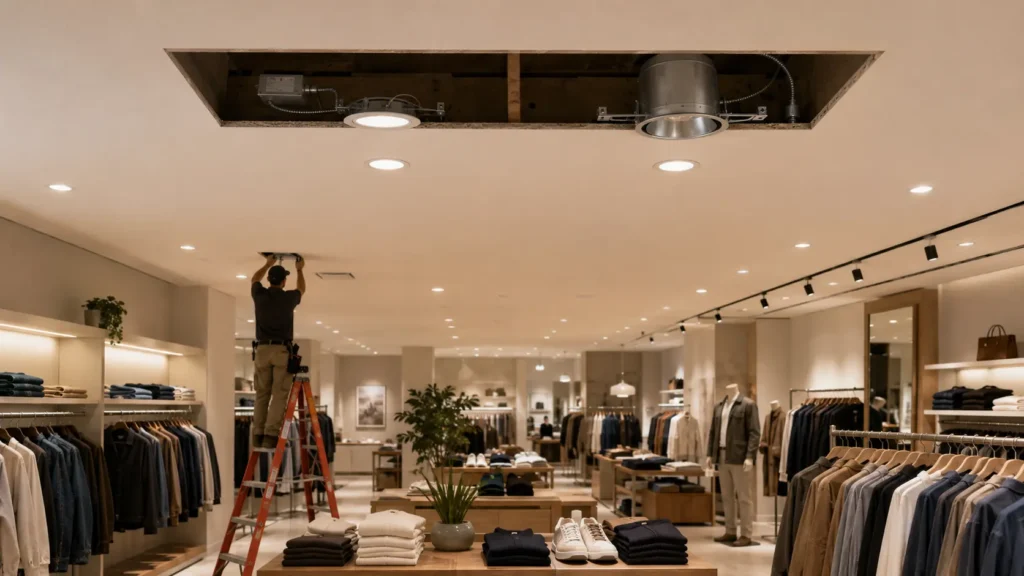
Canless LED downlights and traditional can recessed heads both sit in a cut-out.
They do not share the same housing stack.
The real difference is whether a separate can enclosure is required — and what that does to void depth, labour, and code-compliant recessed lighting paperwork.
إذا كنت لا تزال بحاجة إلى تحديد نوع التوجيه المطلوب (مُدمج، سطحي، قابل للتعديل)، فابدأ بـ طرق تركيب مصابيح LED السفلية مرشد.
تفترض هذه الصفحة أن المسار المخفي مغلق بالفعل.
إنه canless vs can light comparison for commercial and light-commercial ceilings.
أهم النقاط
– Canless (often called a pancake LED downlight) = slim aperture module + remote driver/junction box; no traditional can housing.
– Can = metal housing in the void that holds trim/source (or a retrofit kit).
– Shallow voids and joist conflicts usually favour canless; existing cans and some fire/service strategies still favour a can path.
– “Code-compliant” is listing + rating + install per local authority — not the word “canless” alone.
1. Quick comparison: canless vs can
| الأبعاد | Canless / pancake | Traditional can |
|---|---|---|
| السكن | No separate can; module + remote box | Metal can / housing in the void |
| Typical void | Often ~1.5–2 in planning band (confirm sheet) | Often ~5–7 in for many cans (confirm sheet) |
| الأنسب | New cut-outs, shallow voids, many remounts | Existing cans, some new-build framed housings |
| Parts count | Often one lighting SKU + remote box | Housing + trim/module (or retrofit kit) |
| Insulation contact | Many SKUs IC-rated by design — still check sheet | Only if the housing is IC-rated |
| أسقف مقاومة للحريق | Needs a fire-rated canless model when required | Needs a fire-rated housing (or certified assembly) |
| الوصول إلى الخدمة | Remote box location must stay accessible | Access via can / hatch strategy on sheet |
Neither row wins every job.
Freeze the ceiling build-up first, then pick the stack that clears depth, listing, and service.
🎯 ما هو الفرق الحقيقي في سطر واحد؟
Canless skips the traditional can and runs slim with a remote box; a can path keeps a metal housing in the void for the head.
2. What “canless” and “can” actually mean
A can light (pot light / recessed can) uses a housing cylinder in the ceiling cavity.
The trim or LED module seats into that can.
Canless LED downlights mount the thin light engine at the aperture and move the driver / junction box off the head.
Shops also call many of these a pancake LED downlight or wafer — same idea: low profile, no can.
Both remain غائر if the aperture is flush in the finished plane.
Canless is not surface-mounted.
Surface-mounted skips the cut-out entirely — that fork lives on the installation-methods guide, not here.
🎯 Is canless still a recessed downlight?
Yes — canless is still recessed at the aperture; “canless” only means there is no separate can housing behind the trim.
3. Void depth and placement freedom
Depth is the first matrix that usually decides the canless vs can light comparison.
Typical ceiling void needed in inches: canless or pancake slim about 2; traditional can housing about 6. Planning bands only — verify SKU sheet.
Typical ceiling void needed (planning bands)
Confirm on fixture sheet — product-dependent Canless /pancake (slim)
2
Traditional canhousing
6
Source: Industry planning bands from commercial canless vs can guides; verify SKU sheet
Canless often clears joists, ducts, and shallow plasterboard voids that reject a tall can.
Cans still win when the void already holds listed housings, or when the design calls for a framed new-construction can package.
Measure as-built void at each zone — catalogue photos do not clear clashes.
🎯 When does void depth kill the can path?
When measured cavity plus cable bend cannot clear the can height, switch to a listed canless (or surface) package before ordering.
4. Install and retrofit path (not a full how-to)
Canless downlight installation usually means: cut aperture → wire remote box → clip the slim head.
Labour is often faster on open new work and many drywall remounts.
A can path on remodel may be: keep / replace housing → seat retrofit module — or frame a new can where none exists.
Do not treat “retrofit kit for existing can” as the same SKU family as “canless no-housing.”
They solve different ceilings.
Full step-by-step craft is a separate install topic; freeze the housing family here first.
🎯 Install tip before you cut?
Lock canless vs can (and cut-out size) on the sheet before any hole — wrong family wastes labour and plaster.
5. Code, listing, and fire — a comparison dimension
Code-compliant recessed lighting is not a brand slogan.
Inspectors care about:
- Luminaire listing (e.g. UL / ETL to the applicable standard on the sheet)
- IC vs Non-IC where insulation contacts the fixture
- Airtight / airflow notes where energy code applies
- Fire-rated ceiling assemblies when the floor/ceiling rating must continue through the cut-out
Canless products are acceptable in many jurisdictions متى they carry the required listings and are installed per instructions and local code.
هم لا automatically OK in a fire-rated assembly just because they are thin.
Standard wafer SKUs often fail that gate — you need a fire-rated canless model tested for the assembly (commonly marketed against UL 263 / ASTM E119 style tests — confirm the certificate, not the brochure headline).
Traditional cans face the same logic: the housing must be the listed, fire-rated (or IC) product the schedule requires.
🎯 What paperwork freezes either path?
Listing mark, IC or Non-IC, airtight notes if required, and fire certificates matched to the ceiling — then install per sheet.
6. When canless wins vs when a can still wins
Prefer canless when:
- Measured void is shallow or conflicted by joists / services
- You want one slim aperture SKU plus a remote box
- New cut-outs dominate (no existing cans to reuse)
- The sheet’s IC / airtight / fire ratings match the ceiling strategy
Prefer a traditional can when:
- Existing cans are sound and a listed retrofit module fits
- Spec or AHJ expects a framed housing package already on the schedule
- Service / access strategy is built around can replacement
- The fire or IC path you need is already proven on a can assembly you trust
If neither recessed stack clears depth or fire, revisit surface-mounted on the installation-methods guide — do not force a wafer into an illegal assembly.
🎯 How do you choose in one pass?
Match void + listing/fire + reuse of existing cans; canless wins shallow new cut-outs, cans win proven housing/retrofit paths.
7. Specifier freeze order
- Confirm recessed (not surface) on the ceiling strategy.
- Measure void and map joist / duct clashes.
- Decide canless vs can from depth and reuse.
- Lock listing, IC, airtight, and fire certificates to the assembly.
- Then freeze lumen, CCT, beam, and dimming — not before.
A fit supplier lists mounting depth, remote-box size, IC/Non-IC, and fire certificates on the same datasheet as photometry.
XHLUX supplies commercial recessed LED packages where slim and housing-based paths both appear on the sheet — match the ceiling, then the optic.
ملاحظات ومصادر
Technical notes: Confirm mounting depth, remote driver/junction-box location, IC/Non-IC, airtight claims, and fire-test certificates against the fixture sheet and the ceiling assembly. Use qualified electrical labour for mains work. Local AHJ rules override marketing copy.
Planning bands: ~2 in canless / ~6 in traditional can on the chart are industry education bands from commercial canless-vs-can guides — not a code. Always verify the SKU.
Related reading: طرق تركيب مصابيح LED السفلية for recessed vs surface vs adjustable routing. For commercial recessed housing envelope checks, see LED Recessed Luminaires for Commercial Ceiling Applications.
التعليمات
Are canless lights code compliant?
Yes when the fixture is properly listed (for example UL or ETL), carries the ratings your ceiling needs (such as IC or fire), and is installed per instructions and local code.