XHLUX
XHLUX

White hardware does not automatically disappear against white paint. Good white ceiling track lighting depends on how the rail, adapters, heads, ceiling and light interact from the actual viewing positions.
Use this guide when the design intent says “blend into the ceiling,” but the product schedule says only “white.” For track families, feeds, connectors and circuit choices, start with the دليل أنظمة الإضاءة الموجهة: الأنواع، الأجزاء، وكيفية الاختيار.
If the project is buying a complete rail-and-head package, use the Track Light Kit Buying Guide: 6 Checks Before You Buy for the wider system check.
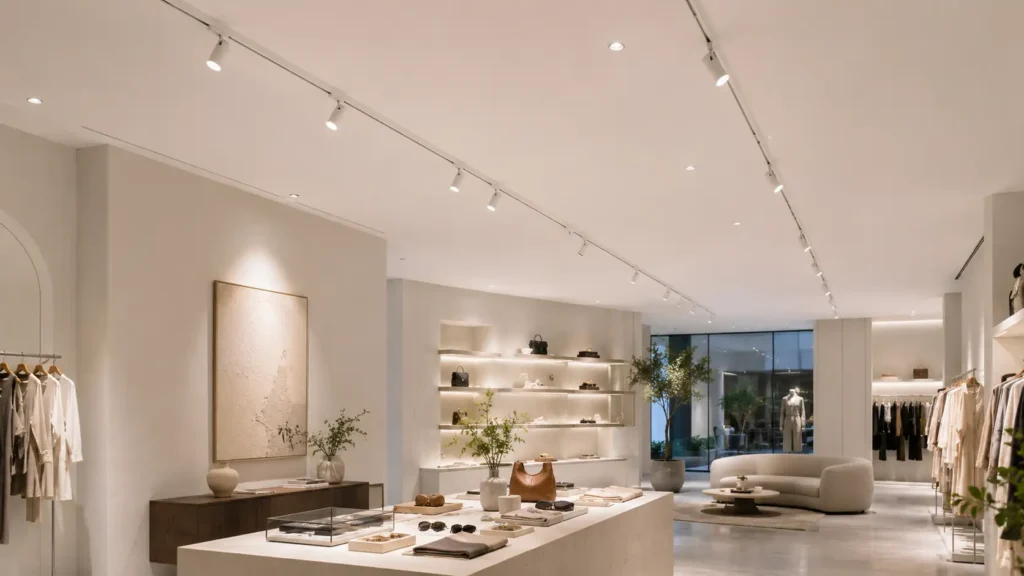
باختصار شديد: “White” is not a complete finish specification. Approve the exact colour, gloss and texture beside the ceiling sample, then review every joint, adapter, head, shadow and bright aperture under the planned lighting. A coordinated white system can look quiet; an untested one can outline every component.
1. Treat white as a measured colour, not a generic name
Two finishes can both be sold as white while differing in lightness, warmth and tint. One may lean slightly blue, another yellow, and a third grey. The difference can become more obvious when a long rail sits directly beside a large painted ceiling field.
ISO/CIE 11664-4:2019 defines the CIE 1976 Lab* colour space using correlates of lightness, chroma and hue. ISO/CIE 11664-6:2022 provides the CIEDE2000 colour-difference calculation. These standards show why “white” alone is not a reproducible project tolerance.
Do not invent a universal acceptable colour-difference number for every ceiling. The visibility of a difference depends on the surfaces, illumination, observer and project expectation. Instead, ask the rail supplier and paint contractor for physical samples and record the approved references.
Check whether every visible part uses the same finish specification:
- Rail extrusion
- Live end, dead end and connectors
- Suspension or mounting clips
- Adapter body
- Driver enclosure where visible
- Luminaire housing and trim
A white finish track head can match the rail but still contrast with the ceiling. Conversely, a rail that matches the paint may be paired with a warmer or greyer adapter.
🎯 Does a product marked “white” match white ceiling paint?
Not necessarily. Approve the actual component and ceiling samples together under relevant illumination.
2. Match gloss as well as colour
Colour is only one part of appearance. A glossy powder-coated rail can catch bright reflections while a flat ceiling scatters light diffusely. Even if their colour coordinates are close, the reflected highlight can draw a sharp line across the ceiling.
ISO 2813:2014 specifies gloss measurement for suitable non-textured coatings at 20°, 60° and 85° geometries. That does not make a measured rail and a textured ceiling visually identical, but it confirms that gloss is a separate property that should not be hidden inside the word “white.”
Compare these combinations during sample approval:
| Rail finish | Ceiling finish | Likely visual issue | ما الذي يجب فحصه؟ |
|---|---|---|---|
| Gloss or semi-gloss | Flat paint | Linear highlights on the rail | View toward windows and luminaires |
| Matt | Satin paint | Rail may look duller or greyer | Review in daylight and electric light |
| Smooth powder coat | Textured plaster | Different reflection pattern | Inspect from shallow viewing angles |
| Mixed gloss accessories | Uniform ceiling | Joints and adapters read as separate parts | Approve the complete assembled system |
Do not compare finish names from two catalogues as though “matt” were a universal measured value. Request samples from the actual production finish where appearance is critical.
🎯 Is a matt white rail always less visible?
No. Matt can reduce sharp reflections, but colour, texture, shadows and component size can still reveal the system.
3. Account for ceiling paint, texture and changing light
A sprayed acoustic ceiling, smooth gypsum board and hand-rolled paint surface do not reflect light in the same way. Texture creates small highlights and shadows; a smooth metal rail forms a continuous manufactured edge.
The visual comparison also changes through the day. Daylight from one side can reveal a colour cast or surface sheen that is quiet under warm electric light. At night, uplight, reflected display light or a bright wall can alter the apparent contrast again.
لهذا السبب white track rail options should be reviewed against the real ceiling specification rather than against a white screen or printed colour chip.
Use a portable sample board that includes:
- The specified substrate and preparation
- The complete primer and paint system
- The intended application method and texture
- A rail section with an end cap and connector
- One adapter and the proposed head
View it from the entrance, principal circulation routes and seated or working positions. A match judged from 300 mm away may not predict the continuous line seen across a room.
🎯 When should the finish be reviewed?
Review it under daylight and each planned electric-light scene, from the positions that matter to occupants.
4. Design the whole assembly, not a white rail alone
The rail is only one visible shape. Live ends, couplers, corner connectors, adapters, switches and luminaire bodies introduce joints and changes in depth. Their proportions can make the system read as a sequence of objects even when every part is nominally white.
في minimalist track lighting design, visual order matters more than the finish label. Align joints with architectural lines where practical, keep unnecessary adapters out of focal sightlines, and avoid short leftover rail sections that create a fragmented ceiling pattern.
The diagram shows visual principles, not a universal product ranking. A larger head can be appropriate when its output, optic or thermal design requires it; the point is to approve that visual weight knowingly.
🎯 Can matching rail paint hide oversized adapters?
No. Colour coordination cannot remove changes in scale, depth or joint rhythm.
5. Predict shadow lines from the real mounting detail
An object can match the ceiling colour and remain visible because it interrupts the light. Rail depth, mounting clips and adapters can cast lines or patches that outline the system more strongly than the finish itself.
Shadow prominence depends on light direction, distance from the ceiling and surrounding brightness. Grazing daylight can make a shallow rail edge conspicuous. A suspended rail creates a deliberate gap and should not be described as visually flush simply because it is white.
During the mock-up, inspect:
- Shadow below both sides of the rail
- Dark gaps at end caps and connectors
- Adapter shadows when heads are aimed
- Reflections from nearby walls or displays
- Appearance with some heads switched off
- Changes when daylight reaches the ceiling obliquely
Do not retouch a product photograph and use it as finish approval. The project needs the mounting detail and lighting direction that will exist on site.
🎯 Why can a colour-matched rail still have a dark outline?
Its depth and mounting geometry can block directional light and create a visible shadow line.
6. Control glare and ceiling contrast
Attention is not drawn only by the rail. A bright aperture, exposed reflector or sharp highlight can make the entire track location visually dominant.
CIE S 017:2020 defines glare as a visual condition in which discomfort or reduced ability to see detail is caused by an unsuitable distribution or range of luminance, or by extreme contrasts. CIE 232:2019 addresses discomfort from luminaires with non-uniform source luminance. These principles matter because a white housing cannot neutralise a conspicuously bright source.
A bright ceiling track lighting layout should not mean uncontrolled ceiling contrast. Check shielding, aiming, source recession and beam choice from normal sightlines. A head pointed steeply across the room may expose its aperture to more observers than one aimed toward a nearby target.
Ceiling brightness also changes perceived integration. A rail may look quiet on a moderately lit ceiling but become a grey silhouette against a very bright daylight zone. In a darker ceiling area, the illuminated aperture may become the dominant feature instead.
🎯 Does painting the housing white solve glare?
No. Glare depends on source luminance, shielding, distribution, position and the observer’s view.
7. Approve one complete mock-up before the purchase order
Finish approval should cover the assembled system, not isolated chips. Build one representative section with the intended rail, feed, connector, adapter, head, ceiling build-up and control scene.
Record the decision so production substitutions do not reopen it later:
| Approval item | Evidence to retain |
|---|---|
| لون | Manufacturer finish code, ceiling paint code and dated samples |
| Gloss and texture | Approved physical surfaces under project lighting |
| Component consistency | Rail, ends, connectors, adapters and heads assembled together |
| Visual proportions | Photographs from agreed viewing positions |
| Shadows | Daylight and electric-light scene review |
| وهج | Aiming positions, optic codes and observer check |
| Production control | Approved sample retained for incoming inspection |
If matching is critical, require the supplier to notify the project team before changing coating source, finish code or visible accessory. For long programmes, compare later deliveries with the retained approval sample rather than relying on the word “white” in the order description.
XHLUX can coordinate rail, adapter and track-head finishes for project-based supply, but final approval should still use the actual project ceiling and lighting conditions.
🎯 What should be approved before ordering the full quantity?
Approve one complete installed assembly under the relevant daylight and electric-light scenes.
ما الخطوة التالية؟
- Collect the ceiling paint build-up and physical sample.
- Request the actual rail, accessory and head finish samples.
- Assemble one representative section with real joints and adapters.
- View it from principal sightlines under every planned lighting scene.
- Record the approved finish codes, optic, aiming and sample before releasing the order.
ملاحظات ومصادر
- ISO/CIE 11664-4:2019, Colorimetry, Part 4: CIE 1976 Lab colour space*.
- ISO/CIE 11664-6:2022, Colorimetry, Part 6: CIEDE2000 colour-difference formula.
- ISO 2813:2014, Paints and varnishes, Determination of gloss value at 20°, 60° and 85°; reviewed and confirmed in 2025.
- CIE S 017:2020, International Lighting Vocabulary, 2nd Edition.
- CIE 232:2019, Discomfort Caused by Glare from Luminaires with a Non-Uniform Source Luminance.
External authorities are named for verification; no external clickable links are included.