XHLUX
XHLUX
DOE commercial-lighting retrofit guidance states that fluorescent troffer projects converted to LED can deliver 20%–60% project-level energy savings.
DOE’s Interior Lighting Campaign reported mean and median equipment savings of about 54% for retrofit applications across submitted commercial projects (mid-50% range), before treating further controls effects as a separate layer.
That figure describes documented commercial-retrofit populations across sectors and equipment-upgrade types—not an office-only fluorescent/HID→LED guarantee.
It is not a fixed percentage every office can copy.
Actual office lighting energy savings still depend on existing wattage, LED wattage, fixture quantity, annual operating hours and whether controls change run-time or output.
If you are still choosing fixture families for the ceiling plan, start with What Are the Best Lights for an Office?.
باختصار شديد: Use DOE’s 20%–60% troffer-to-LED project range and ILC mean/median equipment savings of about 54% (mid-50% range) as context only. Then calculate your own annual kWh from system watts × quantity × hours by usage group. Convert with a simple energy-rate estimate—or the full tariff when the case supports investment. Finish with simple payback from net project cost.
جدول المحتويات
- How much energy can an office LED retrofit save?
- Why your office may save more or less
- How to calculate energy savings
- A worked retrofit example
- Annual cost savings
- Simple payback
- What about ROI?
- What costs to include
- Do controls increase savings?
- Why wattage savings alone can mislead
- Common calculation mistakes
- Calculation checklist
- When is a retrofit worth evaluating?
- خاتمة
- ملخص
- التعليمات
💡 How Much Energy Can an Office LED Retrofit Save?
Two DOE-sourced figures are enough for a first answer.
| Documented range | What it covers | Source framing |
|---|---|---|
| 20%–60% | Project-level savings when fluorescent troffers are retrofitted or replaced with LEDs | DOE troffer retrofit application guide |
| About 54% (mean & median) | Equipment-upgrade savings for retrofit applications across submitted commercial projects (mid-50% range), before treating further controls as a separate layer | DOE / PNNL Interior Lighting Campaign Results 2015–2019 |
These figures describe documented commercial-lighting retrofit populations and should not be treated as a guaranteed saving for every office.
LED office retrofit energy savings still have to be calculated from the project’s own inputs.
🎯 Can every office claim 50% savings?
No. Use the DOE ranges as context, then calculate from your wattage, quantity and operating hours.
🔍 Why Your Office May Save More or Less
A single percentage hides the inputs that move the result.
| مدخل | Why it changes savings |
|---|---|
| Existing system wattage | A higher baseline usually leaves more room to cut load |
| Proposed LED wattage | Sets the new connected load per fixture |
| عدد الأجهزة | Scales total connected load; one-for-one is not always true |
| Annual operating hours | Turns wattage into annual kilowatt-hours |
| Lighting controls | Can further reduce hours or output after the fixture swap |
Controls can change the result.
Their actual savings depend on the control strategy and how the space is used.
🎯 Why do advertised savings percentages disagree?
Because projects start from different baselines, hours, quantities and control scopes.
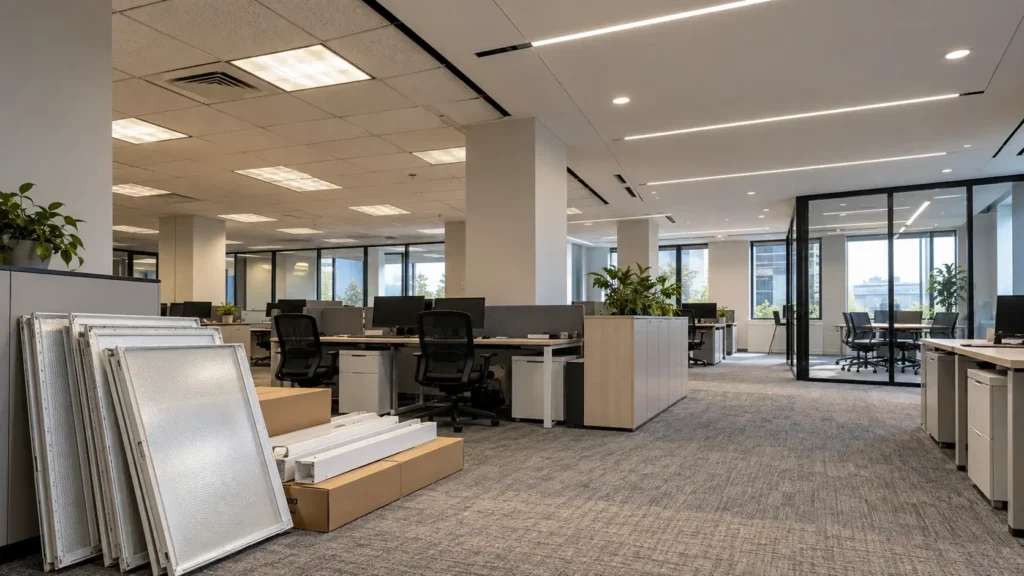
🧮 How to Calculate Office Lighting Energy Savings
DOE commercial lighting evaluation practice estimates annual savings from baseline and efficient fixture inventories using wattage, quantity and operating hours.
Step 1 — Calculate existing lighting energy use
Existing annual kWh = existing system watts × fixture quantity × annual operating hours ÷ 1,000
يستخدم system watts.
Do not use lamp nominal watts alone when the ballast or driver changes the real draw.
If different office zones have different operating schedules, calculate each usage group separately and add the results together.
Step 2 — Calculate proposed LED energy use
LED annual kWh = LED system watts × quantity × annual operating hours ÷ 1,000
If the retrofit changes fixture count, do not force a one-for-one assumption.
Apply the same usage-group split when proposed hours differ by zone.
Step 3 — Calculate annual energy savings
Annual kWh savings = existing annual kWh − LED annual kWh
Step 4 — Calculate energy savings percentage
Energy savings % = annual kWh savings ÷ existing annual kWh × 100%
Only after Step 4 should you answer:
“What percentage does this project save?”
Do not reverse the order and invent 50% first.
🎯 What is the minimum data set for a savings estimate?
System watts, quantity and annual operating hours for both the existing and proposed systems.
📋 A Worked Office Retrofit Example
Example assumptions — not universal values
- 100 fixtures
- existing system = 72 W each
- proposed LED = 36 W each
- 10 hours/day
- 250 working days/year → 2,500 hours/year
Existing
72 × 100 × 2,500 ÷ 1,000
= 18,000 kWh/year
قاد
36 × 100 × 2,500 ÷ 1,000
= 9,000 kWh/year
Savings
18,000 − 9,000
= 9,000 kWh/year
Energy reduction
9,000 ÷ 18,000
= 50%
This 50% result comes from the example assumptions. It is not an XHLUX claim that every office retrofit saves 50%.
🎯 Why show a 50% example at all?
To make the formula readable—not to market a fixed office saving rate.
💵 How to Calculate Annual Cost Savings
For a simple energy-only estimate:
Annual energy-charge savings = annual kWh savings × applicable energy rate
Do not borrow a national “average” tariff and treat it as your project rate.
Example rate only: if the applicable energy rate is $0.15/kWh as an assumption,
9,000 × 0.15
= $1,350/year
That figure is a simple energy-charge estimate—not a complete annual bill reduction. Commercial tariffs may also include time-of-use energy charges, demand charges and fixed charges. Energy and demand charges may respond differently to a lighting retrofit, while fixed charges usually do not change with energy use.
If the tariff includes time-of-use or demand charges, use the actual tariff structure rather than a single blended $/kWh rate when the calculation is being used for an investment decision.
🎯 Which electricity rate should enter the calculator?
For a quick energy-only check, the applicable energy rate from recent bills. For an investment case with TOU or demand charges, the full tariff structure.
⏱️ How to Calculate Simple Payback
Simple payback answers a practical question first:
How long until recurring savings cover the net project cost?
Simple payback period = net project cost ÷ annual recurring savings
Net retrofit cost
Include, as applicable:
- luminaires / retrofit kits
- السائقين
- installation labour
- wiring / accessories
- disposal
- commissioning
- minus rebates / incentives that the project has already agreed in writing
Incentives that are still only provisional should not shrink the cost.
🎯 What does simple payback leave out?
Time value of money and benefits after the payback year—those belong in a fuller financial review.
📈 What About ROI?
“ROI” is often used loosely in retrofit marketing, so the calculation period must be stated.
One clear form is:
ROI over X years = (cumulative savings over X years − net project cost) ÷ net project cost × 100%
Here, cumulative savings means the sum of recurring benefits over the stated period—energy-charge savings from the estimate above, plus maintenance savings only when project data supports them. It is not a figure that has already subtracted the project cost.
State the horizon:
- over 5 years
- over 10 years
- over the project life you are using for the case
Do not publish “ROI = 300%” with no period.
Simple payback ≠ lifecycle ROI.
This page does not expand into NPV or IRR.
أن office lighting ROI calculator is only useful when every input and the time horizon stay visible.
🎯 Can ROI be quoted without a time period?
No. State the years covered, or the figure is not reproducible.
🧾 What Costs Should Be Included in an LED Retrofit?
Fixture price alone is not the full installed retrofit cost.
| Cost / saving item | Include? |
|---|---|
| LED fixtures / retrofit kits | نعم |
| Installation labour | نعم |
| Electrical modifications | If required |
| أدوات التحكم | If included in this scope |
| Rebates / incentives | Subtract only if the project has already agreed them in writing |
| توفير الطاقة | نعم |
| Maintenance savings | Only if supported by project data |
| HVAC interaction | Do not assume unless calculated |
Maintenance savings must not be invented.
Include them only when the project knows existing replacement frequency, labour cost, ballast replacements and a defensible LED maintenance expectation.
Where continuous runs carry the ambient load after retrofit, compare أضواء خطية LED against the required wattage and glare criteria—not against a marketing percentage.
🎯 What is the most common hidden cost omission?
Installation labour and electrical modifications that never appear in a fixture-only quote.
🎛️ Do Lighting Controls Increase the Savings?
Yes, they can.
Occupancy sensing, scheduling, dimming and daylight response can further change hours or output after the LED swap.
DOE retrofit guidance also notes that multiple control strategies may help more than one strategy alone, but the energy savings are not simply additive.
Sensor placement, daylight zoning, energy-code requirements and control protocols require separate design checks. For a retrofit savings estimate, keep the controls input limited to defensible changes in operating hours or output.
🎯 Should controls savings be stacked on top of a 54% equipment figure automatically?
No. Enter the post-control hours or reduction the project can defend separately.
⚠️ Why Wattage Savings Alone Can Mislead
Cutting 72 W to 36 W does not automatically mean the retrofit succeeded.
Still check:
- illuminance against the project requirement
- distribution
- وهج
- colour rendering
- fixture quantity
- real operating conditions
Saving energy by under-lighting the office is not a successful retrofit.
Office lighting standards and frameworks such as EN 12464-1, IES RP-1-24 and WELL show why a single lux target is not a complete specification. Use that standards-and-frameworks review when the retrofit case also has to defend visual quality.
Where discrete points stay in the plan, check أضواء LED سفلية against distribution and glare after the wattage case is built.
🎯 Is a lower wattage enough to choose the retrofit?
No. Keep light level, glare and distribution inside the same decision as the energy cut.
❌ Common ROI Calculation Mistakes
- Using lamp watts instead of total system watts
- Assuming every fixture runs the same hours
- Using an internet electricity rate instead of the actual utility rate
- Ignoring different fixture quantities before and after retrofit
- Counting controls savings twice
- Using unverified maintenance savings
- Quoting a payback or ROI without showing the assumptions
A trustworthy retrofit calculation should be reproducible from the inputs.
That is the difference between a real commercial office lighting energy-reduction case and a brochure number.
🎯 What makes a savings claim trustworthy?
Named inputs, named rate, named cost basis and a percentage you can recalculate.
✅ Office LED Retrofit Calculation Checklist
| مدخل | Existing | Proposed |
|---|---|---|
| عدد الأجهزة | ___ | ___ |
| System watts / fixture | ___ | ___ |
| Annual operating hours | ___ | ___ |
| Annual kWh | calculated | calculated |
| Electricity rate | — | ___ |
| Annual energy cost | calculated | calculated |
| Installed cost | — | ___ |
| Agreed incentive | — | ___ |
| Annual savings | — | calculated |
| Simple payback | — | calculated |
Fill the blanks before arguing about any advertised percentage.
🎯 What should be finished before comparing supplier quotes?
The input table above, so each quote is judged on the same baseline.
🏁 When Is an Office LED Retrofit Worth Evaluating?
Do not invent a universal rule such as “under three years is good” or “over five years is bad.”
PNNL’s reported project examples show how widely simple payback can vary. Several projects were around 3–5 years, while federal-project examples reached 10, 15 and, in one unusual case, 78 years.
Evaluate when several of these are true:
- existing lighting load is high
- operating hours are long
- existing fixtures already need maintenance
- electricity cost is meaningful to the operating budget
- lighting quality also needs improvement
- renovation work is already planned
The project’s own investment criteria determine whether the resulting payback is acceptable.
أن energy efficient office lighting upgrade is a project decision, not a slogan.
🎯 Is there one correct payback cut-off for every office?
No. Organisation criteria, project life and risk tolerance decide acceptability.
🏁 Conclusion: How Much Can Office LED Lighting Really Save?
Office LED lighting can deliver substantial energy savings, but there is no defensible universal percentage for every office.
DOE commercial-lighting data show that fluorescent troffer-to-LED retrofits have produced project-level savings in the 20%–60% range, while DOE’s Interior Lighting Campaign reported mean and median equipment savings of about 54% for retrofit applications across submitted commercial projects, before treating further controls as a separate layer.
Your own result should be calculated from system wattage, quantity, operating hours (by usage group where schedules differ) and the applicable tariff.
The useful number is not an advertised percentage—it is the saving you can reproduce from your project’s inputs.
Don’t start with a savings percentage. Start with the existing wattage, operating hours and actual electricity rate.
Explore our related blog posts:
- اختيار درجة حرارة لون مصابيح LED لمختلف المناطق التجارية
- How to Choose Linear LED Luminaires for Office and Retail Ceilings
- Why Suspended Linear Lighting Differs in Offices and Lobbies
📌 Summary
- DOE documents 20%–60% project-level savings for fluorescent troffer-to-LED retrofits; this is not a universal office guarantee.
- DOE’s Interior Lighting Campaign reported mean and median equipment savings of about 54% for retrofit applications across submitted commercial projects (mid-50% range), before treating further controls separately.
- Calculate baseline and proposed annual kWh from system wattage, quantity and annual operating hours; sum usage groups when schedules differ.
- For a simple estimate, convert kWh savings with the applicable energy rate; use the full tariff when TOU or demand charges matter for investment.
- Simple payback = net project cost ÷ annual recurring savings.
- Never claim an ROI or payback without stating the assumptions.
التعليمات
ملاحظات ومصادر
- U.S. Department of Energy, LED Retrofit Kits, TLEDs, and Lighting Controls: An Application Guide — fluorescent troffer retrofit/replacement project-level savings 20% to 60%; controls strategies may help together but energy savings are not additive (PDF).
- U.S. Department of Energy / PNNL Interior Lighting Campaign Results: 2015–2019 Results (PNNL-29165) — retrofit applications equipment-upgrade savings mean and median about 54% (mid-50% range across submitted commercial projects); not framed here as an office-only fluorescent/HID→LED typical; reported project simple paybacks vary widely, including multi-year cases and longer outliers (PNNL publication).
- U.S. Department of Energy / NREL Uniform Methods Project, Commercial and Industrial Lighting Evaluation Protocol — annual lighting savings from baseline and efficient fixture wattage, quantity and operating hours; different usage groups summed when hours differ.
- Worked example watts, hours, quantity and $0.15/kWh rate = labelled assumptions for a simple energy-charge estimate only, not a full tariff case or measured project data.
Planning an Office LED Lighting Upgrade?
XHLUX provides commercial office linear lighting and downlight options for retrofit and new-build projects.
For an upgrade, fixture wattage, required light levels, layout and control requirements should be checked together before the savings estimate is finalised.